
How to Search Muskegon County Traffic Court Records
Traffic cases in Muskegon County route through the 60th District Court, and its files are searchable online. The county keeps an online case-search hub that splits cases into circuit, district, and probate groups. Traffic tickets live under the district group. From the hub you reach the MiCOURT search for the 60th District Court, the statewide judiciary portal that serves this court. The portal covers open and closed matters, so a paid or dismissed ticket can still appear.
Gather a few details first. The citation number from the ticket is the fastest way in. If you do not have the ticket, the driver name works, though a common name can return several matches. A date of birth or a case number narrows the list. The Traffic Division also answers phone questions about tickets, license suspensions, and court dates at the first-floor counter of the Hall of Justice.
The steps below follow the normal path from the hub to a result.
- Open the county online case-search hub and choose the District Court option to reach the MiCOURT D60 search.
- Enter the citation or case number if you have it, or type the driver name in the party field.
- Confirm you are searching the 60th District Court and add a date range if the name returns too many hits.
- Open the matching case to review the violation, court date, plea, fine, and disposition.
- From there, pay the ticket, request a hearing, or order a certified copy from the court counter.
Note: Michigan court policy often shows public case data online while limiting document images, so confirm whether a full image is available before you rely on a printout.
Which Courts Handle Muskegon County Traffic Cases
The 60th District Court has exclusive jurisdiction over civil infractions and traffic violations in the county. Its work covers tickets, pleas, hearings, and payments, and most drivers never leave this court. It hears the ticket, sets any fine, and enters the judgment that closes the case. A quick look at the county District Court Traffic Division page shows the range of options a driver has after receiving a ticket.
The Traffic Division page links out to admission, denial, payment, and hearing tools that shape how a case resolves.
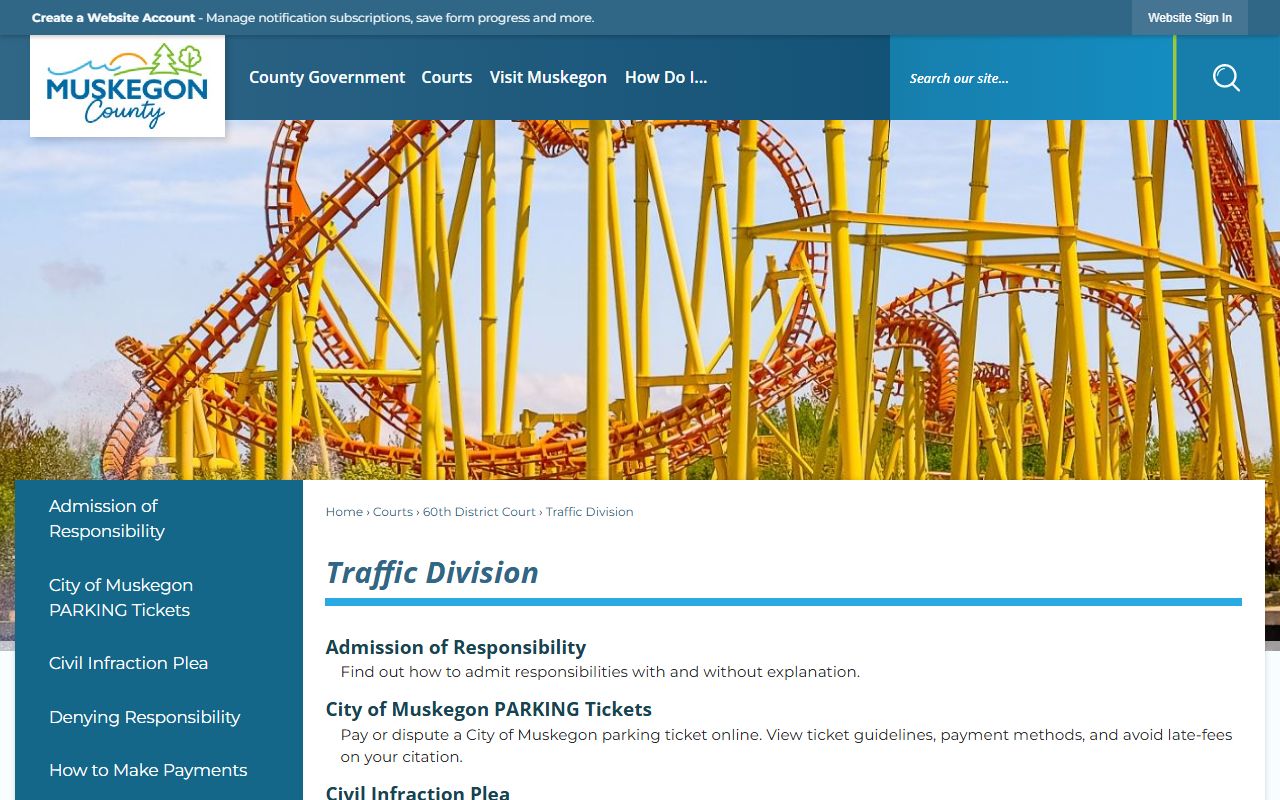
That division handles the front end of every ticket, but some traffic matters touch other offices. A drunk-driving arrest starts in the district court and can move to the 14th Circuit Court if it is charged as a felony after a preliminary exam. Juvenile drivers and city parking citations follow their own tracks. The table below shows where the main pieces sit.
| Court or Office | Traffic Matters Handled | Address |
|---|---|---|
| 60th District Court | Civil infractions, misdemeanor traffic, tickets, pleas, hearings, payments | 990 Terrace Street STE 100, Muskegon, MI 49442 |
| 14th Circuit Court | Felony drunk-driving files after bindover from district court | 990 Terrace Street, Muskegon, MI 49442 |
| Family Division | Juvenile criminal traffic offenses referred from district court | 990 Terrace Street, Muskegon, MI 49442 |
The 60th District Court keeps hours of Monday through Friday, 8:30 a.m. to 4:30 p.m., and closes on holidays. Call 231-724-6294 for general district court questions or the operations line at 724-6302 for ticket and license-suspension help.
Types of Muskegon County Traffic Cases on Record
Muskegon County traffic records cover far more than speeding. The district court file can hold moving violations, equipment tickets, and civil infractions that carry no jail time. Each type carries its own fine schedule and point value, and each shows up in the case search the same way. Knowing the category helps you read the record and plan a response.
- Moving violations - Speeding, careless driving, disobeying a signal or stop sign, and wrong-way driving that add points to a license.
- Non-moving and equipment - Defective equipment, expired plates, and address-change failures that usually add no points.
- Safety infractions - Seat belt and child restraint tickets, which carry a fine but no points in Michigan.
- Commercial and CDL - Violations by commercial drivers, which carry stricter reporting and appearance rules.
- Drunk driving - OWI and OUIL charges, which are criminal matters rather than simple civil infractions.
Local ordinance violations from cities and townships in the county can also land at the 60th District Court. The Traffic Division page links to local ordinance information for drivers who need to confirm the charging authority on a ticket.
What Muskegon County Traffic Court Records Show
A Muskegon County traffic case file is built from a handful of standard fields. Together they tell the full story of a ticket, from the moment an officer wrote it to the day the driver paid or the judge ruled. The record ties the citation to a case number, a violation, a court date, and a final disposition. The inventory below maps each field to what it reveals.
| Field | What It Shows |
|---|---|
| Citation Number | The ticket number the officer assigned, used as the fastest search key. |
| Case Number | The court docket number, often ending in a code such as the district ordinance or misdemeanor suffix. |
| Charge / Violation | The offense charged, such as careless driving or disobeying a stop sign. |
| Court Date | The scheduled hearing or appearance date set by the court. |
| Plea or Response | Whether the driver admitted responsibility, denied it, or requested a hearing. |
| Disposition | The outcome, such as responsible, not responsible, dismissed, or guilty. |
| Fine and Costs | The dollar amount owed, combining the fine, court costs, and any fees. |
| Points Assessed | The Michigan point value tied to the violation, reported to the state. |
| Payment Status | Whether the balance is paid, partly paid, or outstanding. |
A missed court date can add another line to the file. When a driver fails to appear, the record may show a failure-to-appear entry or a bench warrant, along with an added cost. Those entries stay visible in the case history even after the driver clears them.
Muskegon County Traffic Records by Citation or Name
Two paths lead to the same traffic file. A citation or case number points straight at one record and skips the guesswork. A driver name casts a wider net and can surface several people or several tickets for one person. Common names bring the most noise, so a birth date or a court range helps trim the list. The county verifies the D60 search link, but the exact field labels were not fully confirmed during research, so treat the layout below as a conservative guide rather than a fixed form.
| Search Field | Type | Required | Notes / Format |
|---|---|---|---|
| Court | Selection | Yes | Choose the 60th District Court (D60) route from the county hub. |
| Case or Citation Number | Text | No | Use if known; formats resemble docket numbers seen on county records. |
| Party Name | Text | No | Driver name; a common name may return several matches. |
| Case Details | Result link | After results | Opens docket, hearing, and disposition data where public. |
If the online search comes up empty, the ticket may be too new to appear or may sit with a different office. Call the Traffic Division to confirm the court date and balance before you assume the record is missing.
Paying or Contesting a Muskegon County Traffic Ticket
A ticket gives a driver a choice: admit responsibility and pay, or deny it and ask for a hearing. The 60th District Court accepts online and phone payments through GovPayNet, also known as AllPaid. Phone card payments run through 888-604-7888 using pay location code 7225. Card payments post the next business day, and a card fee applies. Do not wait until the last hour, since a payment that clears late can still trigger a missed-deadline entry.
Drivers who deny responsibility follow the Traffic Division pages for admission, denial, and hearing options. Denying a civil infraction leads to an informal or formal hearing, described in the next steps. Bring any witnesses you plan to use. The district court says subpoena forms come from the court clerk, and the party who subpoenas a witness must pay the witness fees.
Young drivers follow a split path. The 60th District Court can accept payments for juvenile civil-infraction traffic tickets, which keeps a minor speeding ticket on the district track. A juvenile criminal traffic offense is different, and the district court cannot take payment on those. For a juvenile criminal traffic charge, the county directs callers to Family Court at 231-724-6421.
The walkthrough below lays out the full path from reading the ticket to resolving it.
- Read the citation and decide whether it is a civil infraction, a misdemeanor, a local ordinance, a parking ticket, or a drunk-driving charge.
- Search the 60th District Court file or call the court for the court date, the amount, and the hearing options.
- To admit responsibility, follow the District Court payment page and confirm whether online or phone payment is accepted for your ticket.
- To deny responsibility, use the Traffic Division denial and hearing pages, and line up any witnesses you need.
- For a missed date, call the court before paying, because a bench warrant cannot be paid with a credit card.
- Check your Michigan driver record separately, since a court payment does not always lift a license suspension right away.
Admission, Denial, and Informal or Formal Hearings
Every Muskegon County traffic citation asks the driver to respond. Admitting responsibility works like a guilty answer to a civil infraction. The driver accepts the violation, pays the fine and costs, and the points post to the state driver record. A driver may also admit responsibility with an explanation and ask the court to reduce the fine, though the court decides whether to grant it.
Denying responsibility opens a hearing. An informal hearing is held before a magistrate without lawyers, where the officer and the driver each tell their side and the magistrate rules. A formal hearing allows attorneys and follows stricter rules of evidence. The Traffic Division links to denial and hearing pages that explain how to request each type. A driver who loses a contested civil infraction hearing can face added court costs on top of the base fine.
Note: A different appeal process applies to informal traffic hearings and small claims, so ask the district court clerk about deadlines before you assume a standard circuit appeal fits your case.
Muskegon County Traffic Fine and Point Schedule
The 60th District Court publishes a fee schedule for common civil infractions. Each entry pairs a total amount with the Michigan point value the state records against the license. You can review the full list on the county traffic fee schedule page, which sets the base amounts drivers see on a ticket.
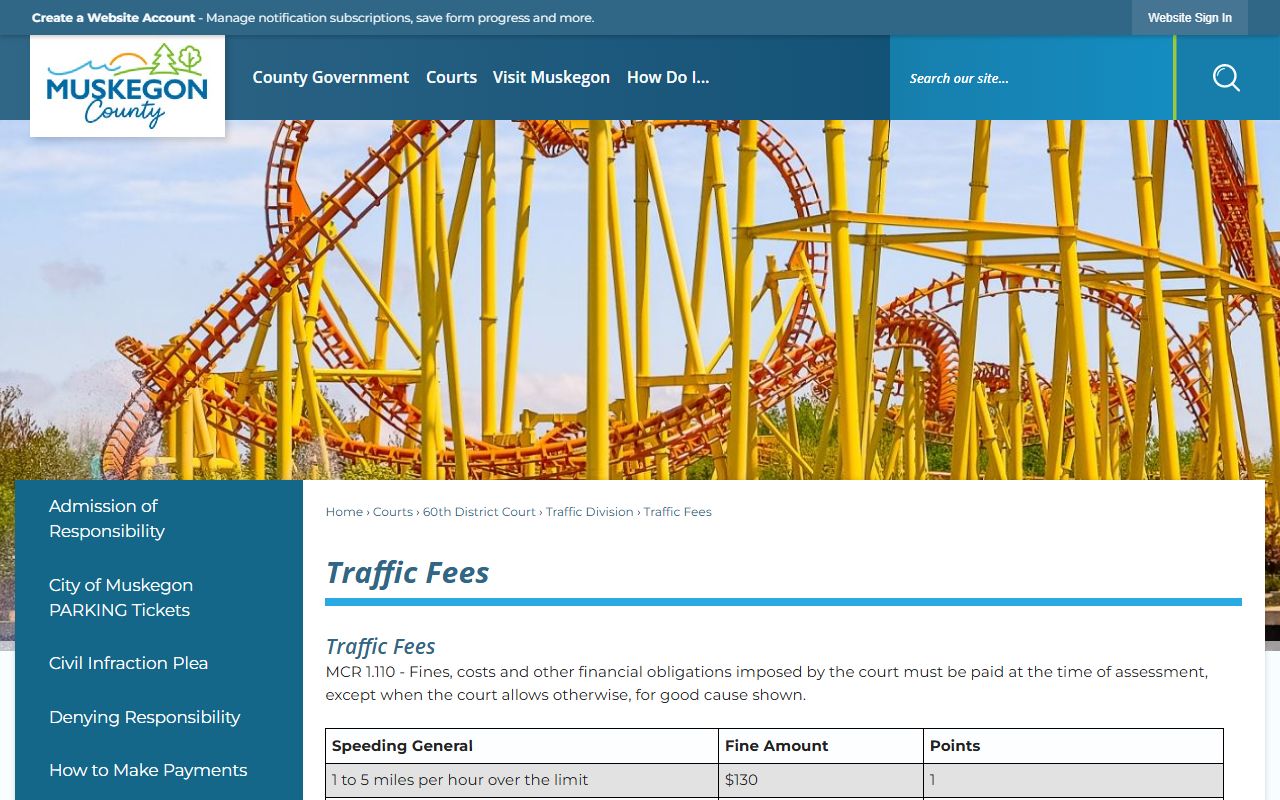
The schedule pairs each violation with a dollar amount and a point value, and a sample of the most frequent tickets appears below. Construction or school-zone amounts are not fixed on the list, so the court asks drivers to call for those figures.
| Violation | Amount | Points |
|---|---|---|
| Careless Driving | $215 | 3 |
| Fail to Stop for School Bus | $240 | 3 |
| Disobey Stop Sign | $140 | 3 |
| Disobey Traffic Control Device | $140 | 2 |
| Disobey Traffic Signal | $135 | 3 |
| Drove Left of Center | $135 | 2 |
| Defective Equipment | $115 | 0 |
| Child Restraint Violation (1 to 4 years) | $105 | 0 |
| Seat Belt Violation | $65 | 0 |
| Construction or School Zone | Contact Court | Contact Court |
Hearing choices carry their own costs. The Family and Juvenile fee schedule lists a non-contested hearing at $60 with no ticket limit, a contested hearing at $110 if the driver is found guilty, and a failure-to-appear cost of $70 plus a $15 money order to the State of Michigan. A drunk-driving matter before a judge carries a $160 cost.
Court Traffic Records vs State Driver Records
Two separate files follow every ticket, and drivers often confuse them. The court traffic record is the case file at the 60th District Court. It shows the citation, the plea, the fine, and the judgment for that one ticket. The Michigan driver record is a different file kept by the Secretary of State. It gathers reported convictions, points, and license status across every ticket a driver has. Fixing one file does not automatically fix the other.
This split matters when a license is at risk. A court payment closes the case file, but the Secretary of State controls suspensions and the point total. To correct a state driver record, a driver works through the Secretary of State, not the court counter. The comparison below shows where each file lives and how to reach it.
| Record Type | Source | What It Shows | How to Access or Correct |
|---|---|---|---|
| Court Traffic Record | 60th District Court and MiCOURT D60 | Citation, case number, plea, court date, fine, and disposition for one ticket | County case search or the district court counter; correct through the court clerk |
| Michigan Driver Record | Michigan Secretary of State | License status, reported convictions, points, suspensions, and revocations | State driver-record channels; correct through the Secretary of State |
| Criminal Traffic Record | Sheriff jail report and district or circuit criminal search | Drunk-driving arrest charges, bond, criminal docket, judge, and custody status | County inmate reports and MiCOURT criminal search |
Because the two files update on different clocks, a driver should confirm both after paying a ticket. A cleared court case can still leave a pending state action if the payment has not yet posted to the license.
Muskegon County Drunk Driving Cases
Drunk-driving charges are not simple traffic tickets. In Michigan an OWI or OUIL charge is a criminal matter that starts at the 60th District Court and can move to the 14th Circuit Court if it is a felony. These cases involve arrest, bond, and a criminal docket rather than a civil infraction fine. The county also runs treatment tracks for repeat offenders through its problem-solving courts, including a Sobriety Court aimed at alcohol and drug cases.
Sobriety Court and Veterans Treatment Court give some drivers an alternative to a standard sentence.
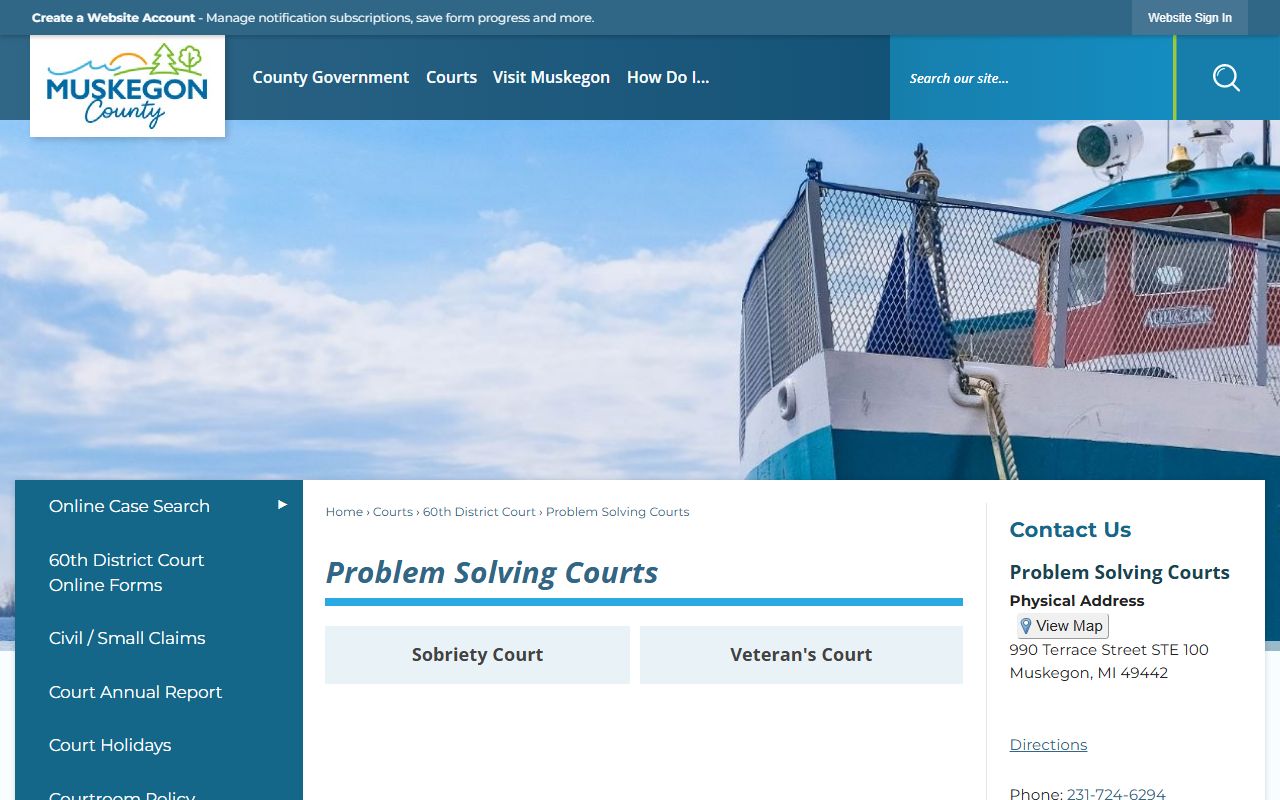
Those programs sit on the criminal side of the docket, so they shape a case in ways the traffic search will not show. For full Muskegon County drunk-driving charge details, including the booking record and the charges filed after an arrest, see the Muskegon County arrest and charge records. That page tracks the criminal side of a traffic arrest.
Public Access Laws for Traffic Court Records
Michigan treats court files as public unless a statute or court rule limits them. Muskegon County traffic case data at the 60th District Court falls under the same access framework as other court records, governed by court rule rather than by county policy alone. The Freedom of Information Act sets the broader public policy for government records, while court rule governs the case files themselves.
Key Statutes:
Michigan Compiled Laws § 15.231 - Sets the public policy that people are entitled to full information about government affairs, subject to statutory limits.
Michigan Court Rule 8.119 - Governs court records, clerk duties, public access, and the limits that make some records nonpublic.
For a county administrative record that is not part of a court case file, the county Freedom of Information Act form is the fallback. Court case data itself, though, is usually handled through the clerk and the online case search rather than a records request.
Sealing or Setting Aside Traffic Records
Michigan lets some convictions become nonpublic, but traffic records follow narrow rules. Civil infractions are not crimes, so they do not fit the standard set-aside process the way a misdemeanor might. A criminal traffic conviction, such as a drunk-driving offense, may qualify under the state set-aside statute and Clean Slate laws, which depend on the offense type, the number of convictions, the waiting period, and statutory exclusions.
Drivers who want to explore a set-aside can buy the set-aside conviction packet at Circuit Court Records for $5.00. The county reports no filing fee for the application itself, though a certified judgment of sentence costs $10.00 for the first page plus $1.00 for each added page. Eligibility is a legal question, so a driver with a criminal traffic conviction should confirm the rules before filing rather than assume a ticket qualifies.
Certified Copies of Muskegon County Traffic Records
A printout from the case search is not a certified record. When a driver needs an official copy for an insurer, an employer, or another court, the copy must come from the court counter with a certification stamp. Circuit Court Records handles certified circuit documents, while the 60th District Court counter serves district traffic files. The court cannot certify a document that a requester brings in from outside.
| Item | Amount |
|---|---|
| Plain copy per page | $1 |
| Certification fee | $10 plus $1 per page |
| Non-contested hearing | $60 |
| Contested hearing if found guilty | $110 |
Order the copy from the office that holds the original file, and allow extra time if the record is an older case that may sit in off-site storage. Older circuit files can take at least five days to retrieve after a request.