
Muskegon County Circuit Court Overview
Michigan runs one statewide court system with the Supreme Court at the top and the Court of Appeals just below it. Beneath those sit the trial courts, split mainly into circuit, district, and probate courts. The circuit court is the trial court of general jurisdiction, which means it has the broadest power to hear cases. In this county, that court is the 14th Circuit Court.
The 14th Circuit Court handles civil cases above the district court's dollar limit, felony criminal cases after they clear the lower court, and family matters such as divorce, paternity, support, custody, and personal protection orders. It also hears appeals that rise from the 60th District Court. The court sits inside the downtown Muskegon court complex on Terrace Street, alongside the district and probate courts.
Because the same building holds several courts, it helps to know which one keeps which record. A felony that begins downstairs in district court can end up as a full circuit case file after the judge sends it up. Knowing that path is the key to finding the record you want on the first try.
Muskegon County Trial Courts and Offices
Several courts and record offices share the county's justice system, and each has its own role and phone line. Most sit at 990 Terrace Street, but a few, such as vital records, do not. The table below lists the main offices, where they are, and what they handle.
| Court / Office | Address | Phone | Role |
|---|---|---|---|
| 14th Circuit Court | 990 Terrace Street, Muskegon, MI 49442 | 231-724-6251 | General-jurisdiction trial court; felonies after bindover; civil over the district limit; family cases; appeals from district court |
| Circuit Court Records | 990 Terrace, 6th Floor, Suite 600 | 231-724-6251 | County Clerk division holding circuit civil, criminal, domestic, and custody files; certified copies |
| 60th District Court | 990 Terrace Street, Suite 100 | 231-724-6294 | Civil up to $25,000; misdemeanors; traffic; small claims; landlord-tenant; felony arraignments and preliminary exams |
| Probate Court | 990 Terrace Street, Muskegon, MI 49442 | 231-724-6241 | Estates, wills, trusts, guardianships, conservatorships, and mental-health matters |
| Friend of the Court | 990 Terrace Street, Family Division | 877-543-2660 | Support, custody, parenting time, and paternity administration within the family division |
| County Clerk, Vital Records | 1903 Marquette Ave., Suite A104 | 231-724-6221 | Marriage licenses, birth, death, and marriage copies, elections, and CPL applications |
| Prosecutor | 990 Terrace Street, Suite 550 | 231-724-6435 | Files and prosecutes criminal charges; victim services |
| Sheriff's Office | 990 Terrace Street, Suite 450 | 231-724-6351 | Jail, inmate lookup, records, and accident reports |
The circuit court and its records division share the same main phone line, since the County Clerk serves as clerk of the 14th Circuit Court. For district cases, small claims, or traffic matters, the 60th District Court is the correct office. For estates and guardianships, the Probate Court handles the file.
Circuit Court vs District Court vs Probate Court
The three trial courts do not overlap much. Each one owns a lane, and the case type usually tells you which court holds the record. The comparison below shows how jurisdiction splits across the county's trial courts.
| Circuit Court | District Court | Probate Court | |
|---|---|---|---|
| Civil limit | Above $25,000 | $25,000 or less; small claims to $7,000 | Estate value, not a civil limit |
| Criminal jurisdiction | Felonies after bindover; trial and sentencing | Misdemeanors; felony arraignment and preliminary exam | None; not a criminal court |
| Family cases | Divorce, custody, support, paternity, PPOs | No | Guardianship and conservatorship of minors and adults |
| Main case types | Felony, major civil, domestic relations | Traffic, landlord-tenant, misdemeanor, small claims | Wills, estates, trusts, mental health |
Appeals also follow this split. A district court decision generally appeals up to the circuit court, while circuit and probate orders generally move to the Michigan Court of Appeals. Small claims and informal traffic hearings follow their own separate appeal rules.
How a Muskegon County Case Moves Through the System
A criminal case rarely stays in one place. Felonies in particular travel between courts as they progress. Knowing the route explains why one charge can appear in two different court files.
Felony flow: Arrest › District Court arraignment › Preliminary exam › Bindover › Circuit Court arraignment › Pretrial › Trial or plea › Sentencing › Michigan Court of Appeals
Every criminal case in the county is filed first at the 60th District Court. A misdemeanor stays there from arraignment through sentencing. A felony, though, begins there only for the arraignment and the preliminary exam. If the judge finds probable cause at that exam, the case is bound over to the 14th Circuit Court. From that point the full felony file, including pleas, trial, disposition, and sentencing, lives in circuit court. A defendant who wants to challenge a circuit conviction can take it to the Michigan Court of Appeals.
Civil and family cases follow a calmer path. A divorce or a large civil suit is filed directly in circuit court, moves through answer, discovery, and motions, and ends in a judgment. Because a single event can touch more than one court, a thorough search often means checking both the district and circuit records for the same person.
Prosecuting Cases in Circuit Court
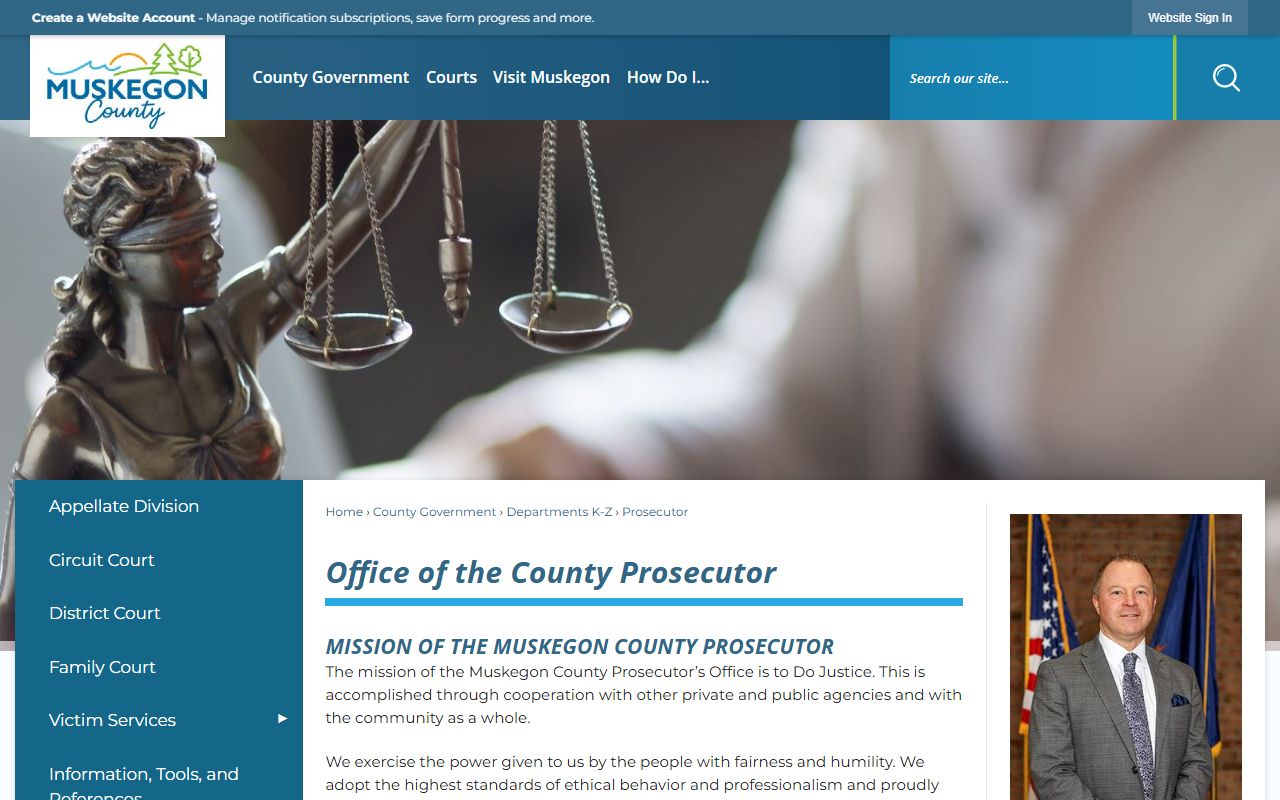
The Muskegon County Prosecutor's Office brings criminal charges on behalf of the people. D.J. Hilson serves as the county prosecutor. The office states its mission simply as doing justice, and it works through appellate, circuit, district, and family divisions. Assistant prosecutors carry felony cases into the 14th Circuit Court after those cases are bound over from the district level.
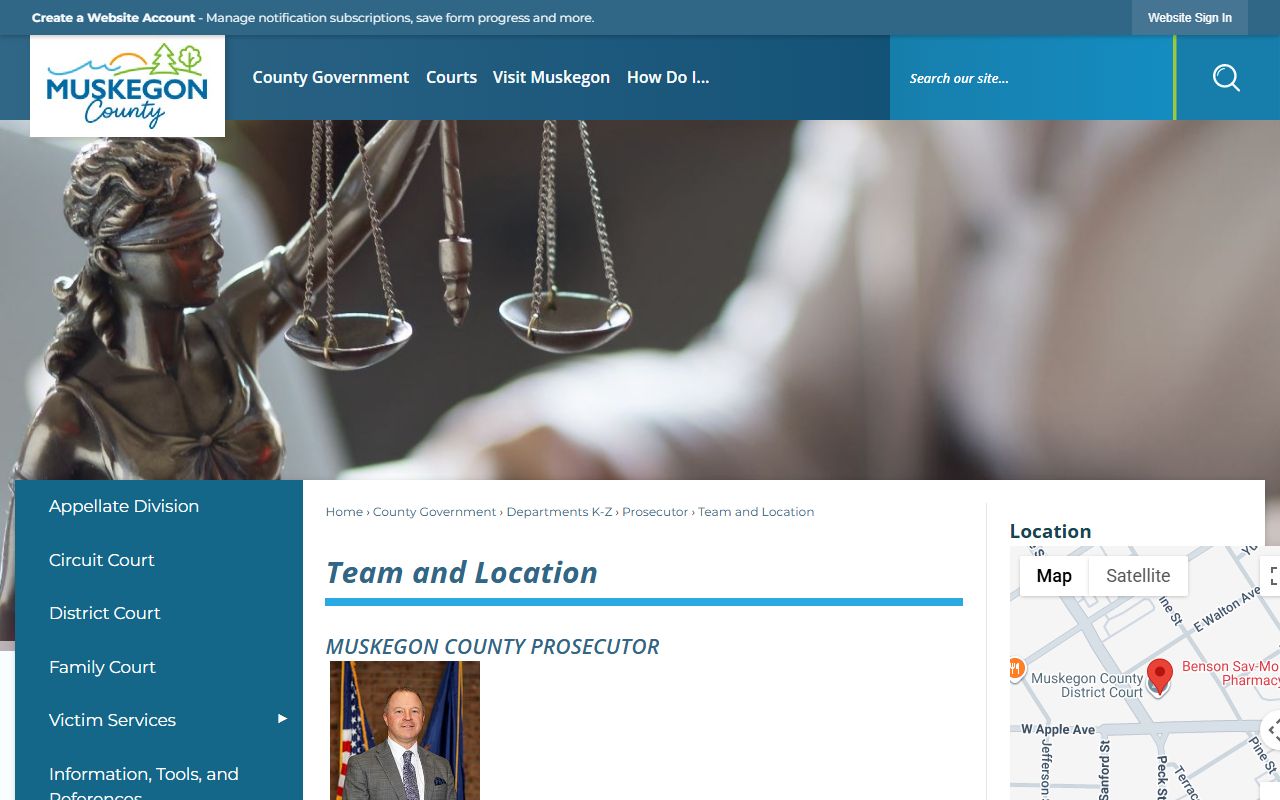
The office also supports crime victims and their families through a dedicated victim-services function. Its team and division contacts, along with the Suite 550 office location, appear on the prosecutor pages.
The prosecutor team and location page lists division contacts and the fifth-floor office suite.
Broader information about the office, its values, and its prosecution divisions appears on the main County Prosecutor page.
Because the prosecutor decides what charges to file and pursue, the office is a useful reference point when reading a circuit criminal file. The charges listed in the court record trace back to the decisions made in this office.
The Muskegon County Public Defender
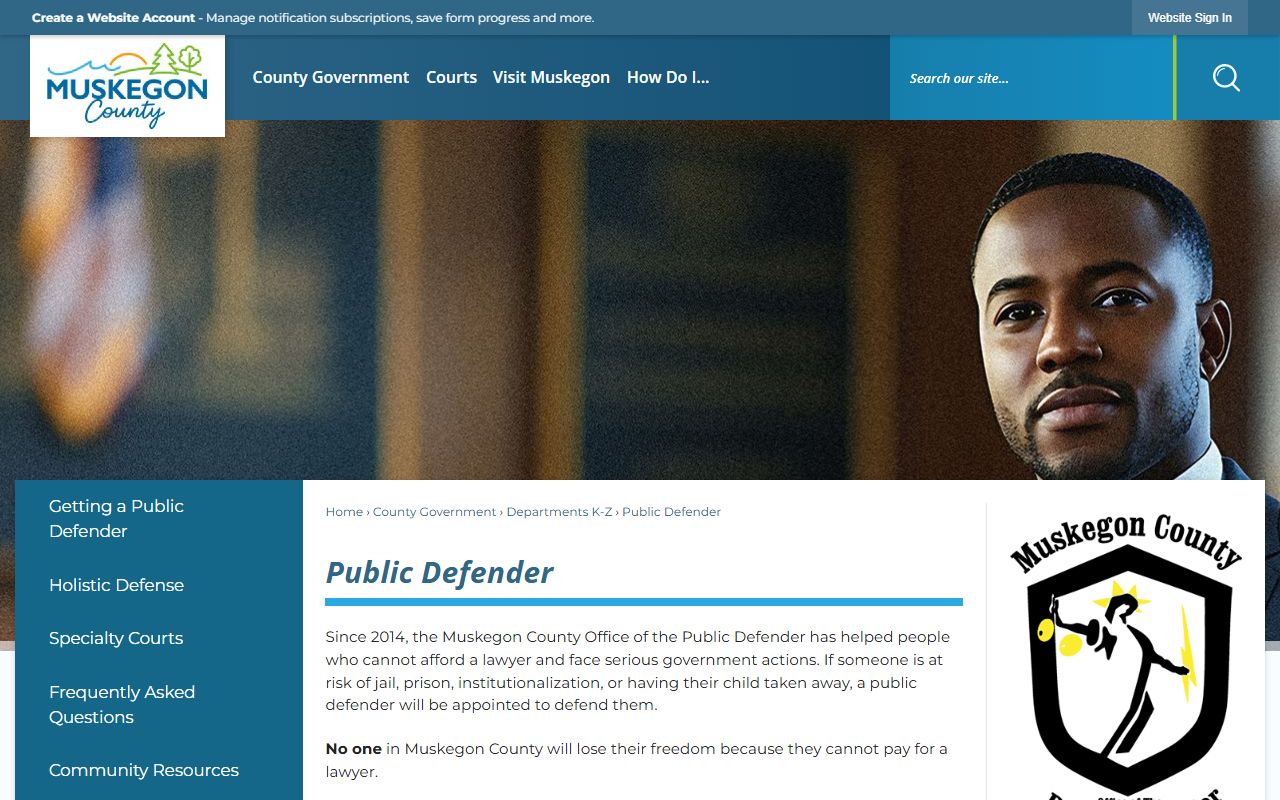
On the other side of a criminal case stands the defense. The Muskegon County Public Defender's Office represents people who cannot afford a lawyer and face serious government action. If a person risks jail, prison, institutional commitment, or the loss of a child, the office can be appointed to represent them.
The office opened in 2014 under a statewide push for stronger indigent defense. It operates on a holistic defense model, which brings in social workers to address both the legal case and the personal issues behind it. The office says no one in the county should lose their freedom simply because they cannot pay for a lawyer.
Details on the office and its holistic model appear on the Public Defender page.
Amy P. Campanelli directs the office. The team includes felony, misdemeanor, research, and investigation staff, and its members appear on the office roster.
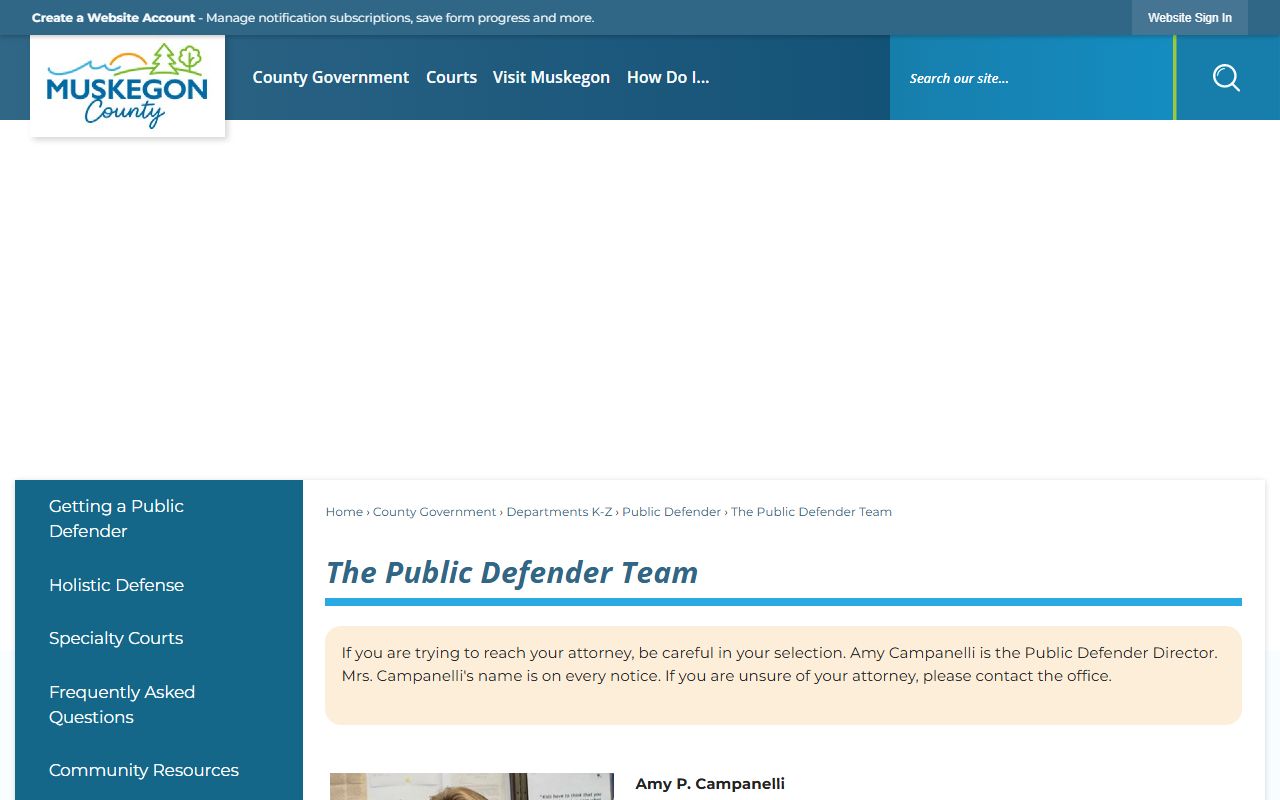
The Public Defender team page lists the director and staff and advises clients who are unsure of their attorney to contact the office directly. Both the prosecution and the defense leave their mark on the circuit case file, from motions to plea agreements.
Friend of the Court in Muskegon County
The Friend of the Court is part of the circuit court's family division and is supervised by the Chief Judge. It helps administer the day-to-day parts of family cases that involve minor children. Its work covers support, custody, parenting time, and paternity administration.
When parents divorce or separate, the Friend of the Court often manages the ongoing orders that follow, such as child support collection and parenting-time enforcement. Its automated phone line handles routine questions and account information. Because these matters can be sensitive, some family and juvenile files carry access limits even though the court maintains them.
Family case files themselves, including divorce, paternity, support, custody, and personal protection orders, are held by Circuit Court Records. On-site family files run from 2009 to the present, while older files are stored off site and must be ordered.
Specialty Courts and Circuit Court Records Access
The county runs several problem-solving courts that can shape how a criminal case ends. Sobriety Court is a therapeutic program for repeat alcohol and substance-abuse offenders. Veterans Treatment Court serves veterans facing charges tied to substance abuse or service-related mental health. Mental Health Court helps people with mental-health and co-occurring disorders. These programs offer supervision and treatment instead of a standard sentence, and completion can change a case outcome that appears in the court record.
To reach the case files, Circuit Court Records is the public access point for circuit civil, criminal, domestic, and custody records. The public may view files at the counter, and certified copies are available for a fee. For quick case status, the county also points users to the state MiCOURT case search for the 14th Circuit Court, which shows public case information online.
Note: An online case printout is not a certified record, so request certified copies from Circuit Court Records when a bank, employer, or another court requires an official document. For a broader look at how to pull files and copies, the county clerk's office manages circuit court records access and certified copies. Older circuit files may take at least five days to retrieve from off-site storage.