Criminal Court Records in Muskegon County
In Muskegon County, a criminal court record is the official case file the court clerk opens the moment charges are filed. It is more than a single arrest note. The file grows as the case moves, and each event is logged in order. The People of the State of Michigan brings the case, and the named defendant answers it. Every charge, plea, motion, and order joins the record until the case closes. Because the file is built stage by stage, reading it in order shows the whole path of a case.
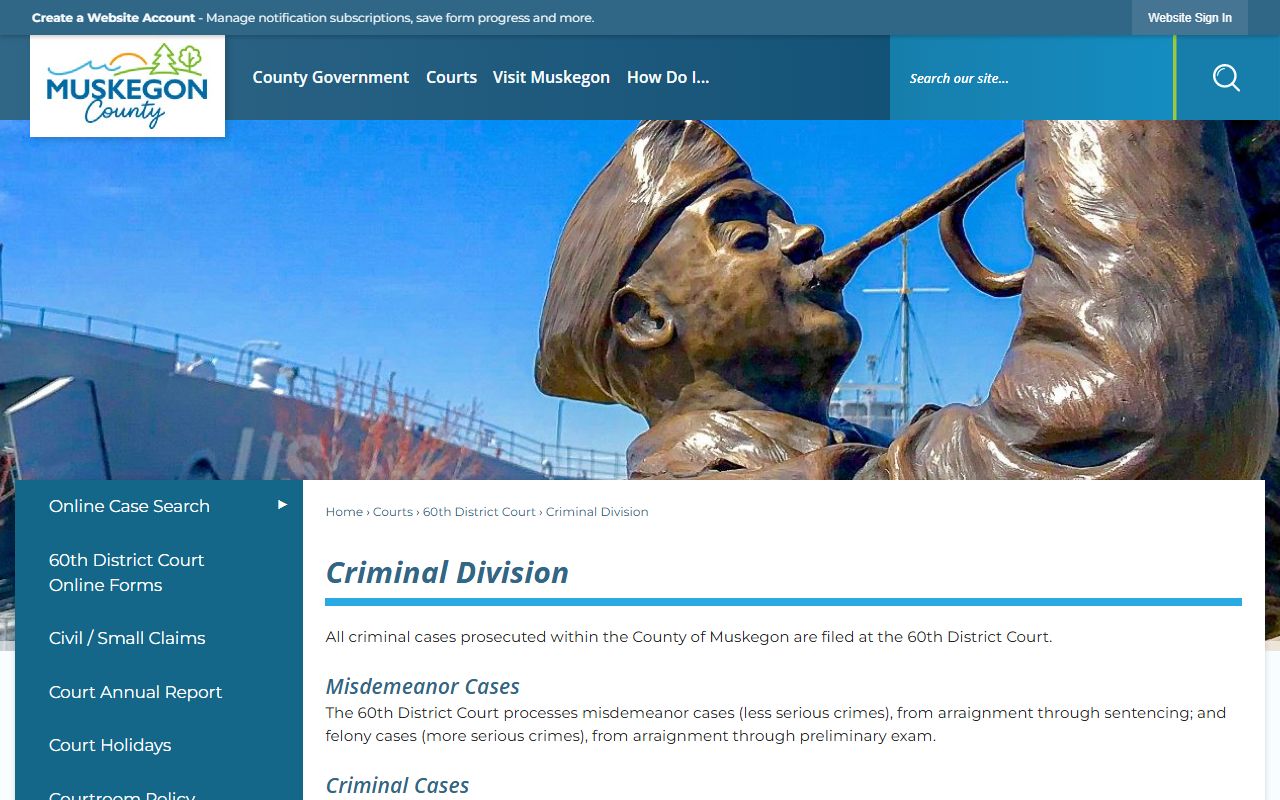
Two trial courts share the criminal workload. All criminal cases prosecuted in the county are filed first at the 60th District Court. Misdemeanor cases stay in District Court from arraignment through sentencing. Felony cases begin there too, but only for the arraignment and the preliminary exam. When a judge finds probable cause, the felony is bound over to the 14th Circuit Court. That court then keeps the full felony case file through plea, trial, disposition, and sentence.
The county explains this split on the 60th District Court criminal division page, which lists common charges from assault and battery to drug offenses, theft, and murder. That page confirms that misdemeanors and the early felony stages both run through the district court before a case ever reaches Circuit Court.
How to Search Muskegon County Criminal Court Records
Muskegon County criminal court records are searched online through the state court system. The county keeps a single Online Case Search hub that splits cases into Circuit Court, District Court, and Probate or Juvenile matters. From there, the MiCOURT tool runs the actual search for each court. The full range of case types, from civil to family, is covered in the broader set of Muskegon County court records.
- Open the county Online Case Search hub and pick the court level that fits the charge.
- Choose the 60th District Court for misdemeanors and early felony events, or the 14th Circuit Court for a felony file after bindover.
- Search by the defendant name, or by the case number when you have it.
- Open the case to read the docket, the charges, and the disposition.
- Ask Circuit Court Records for a certified copy when a portal printout will not do.
Appeals and higher-court opinions are searched through the Michigan Courts case search, which covers the Court of Appeals and the Supreme Court. For older felony files, the counter is often faster than the portal. Circuit Court Records keeps criminal files from 2013 to the present on site, and older files sit off site and take at least five days to pull.
Assistant prosecutors handle these cases, and the county describes that work on the Prosecutor's District Court division page. The prosecutor decides which charges to file, so the charges you see in the record trace back to that office rather than to the arresting officer.
Stages of a Muskegon County Criminal Case
A criminal case moves through set stages, and the record marks each one with a dated entry. Reading those entries in order tells the story of the case. The docket starts at the charge and ends at the sentence, with pleas, motions, and hearings in between. Felony and misdemeanor files share the same basic path, though a felony adds a bindover step that a misdemeanor does not.
Case flow: Charges Filed › Arraignment › Pretrial / Motions › Plea or Trial › Disposition › Sentencing
| Stage | What Happens |
|---|---|
| Arraignment | The first court appearance. The defendant hears the charge, the possible penalty, and the bond, and may enter a plea. In felony cases this happens in District Court. |
| Pretrial / Motions | Lawyers trade information, argue motions, and discuss a plea. Felony cases add a preliminary exam, where a judge tests probable cause before bindover. |
| Plea or Trial | The defendant pleads guilty or no contest, or the case goes to trial before a judge or jury. The verdict or plea is recorded. |
| Sentencing | After a conviction or plea, the judge imposes the sentence. The record notes jail, prison, probation, fines, costs, and restitution. |
What a Muskegon County Criminal Court Record Shows
Once the file is open, the docket lists names, dates, charges, and money in a fixed set of fields. The same fields appear whether the case is a misdemeanor in District Court or a felony in Circuit Court. Knowing what each field means makes the record easy to read. Much of this same information also shows up on the sheriff's jail report when a defendant is in custody.
| Field | What It Shows |
|---|---|
| Case Number | The court's unique ID for the case. The suffix signals the court and case type, such as SM for a misdemeanor or FH for a circuit-level felony. |
| Defendant | The person charged. Criminal files read as People of the State of Michigan versus the defendant. |
| Charges | Each offense, tied to a Michigan statute or a local ordinance, with its level and count. |
| Plea | How the defendant answered, such as guilty, not guilty, or no contest. |
| Disposition | The outcome of each charge, such as convicted, dismissed, or acquitted. |
| Sentence | The punishment ordered, including jail or prison time, probation, fines, and restitution. |
Note: A single arrest can produce several charges, and each charge can reach its own separate disposition within the same case file.
Charges vs. Convictions
Being charged is not the same as being convicted. A charge is only an accusation that a crime was committed. A conviction is a finding of guilt, entered by a plea or a verdict. A criminal court record can show charges that were later dropped, dismissed, reduced, or that ended in an acquittal. The charge itself stays visible in the file even when it did not lead to a conviction. For a closer look at how charges are filed and how their status changes, see the Muskegon County arrest records and court charges.
| Charge | Conviction | |
|---|---|---|
| Stage | Accusation | Verdict or plea |
| Burden of Proof | Probable cause | Beyond reasonable doubt |
| Public Record | Yes | Yes |
Reading Dispositions and Sentences
A disposition is the outcome the court records for each charge. Common dispositions include guilty, not guilty, guilty by plea, dismissed, and nolle prosequi, which means the prosecutor chose not to pursue the charge. A no contest plea, sometimes shown as nolo, resolves the case without an admission of guilt but still counts as a conviction for sentencing.
The sentence sits next to the disposition. A jail term points to time in the county jail, usually for misdemeanors and shorter terms. A prison term routes the defendant to the Michigan Department of Corrections. Probation places the person under community supervision with conditions. Many sentences mix a fine, court costs, and restitution to a victim. Some defendants enter a problem-solving court, such as Sobriety Court or Veterans Treatment Court, which changes how the sentence and supervision appear in the record.
Sealed vs. Expunged and Set-Aside Records
Some criminal court records are removed from public view over time. Michigan calls this a set-aside, though many people still say expungement. A sealed record is hidden from public search but kept by the court. A set-aside goes further and treats an eligible conviction as though it never happened for most public purposes. Muskegon County Circuit Court Records sells a set-aside conviction packet, and the county charges no filing fee for the application itself.
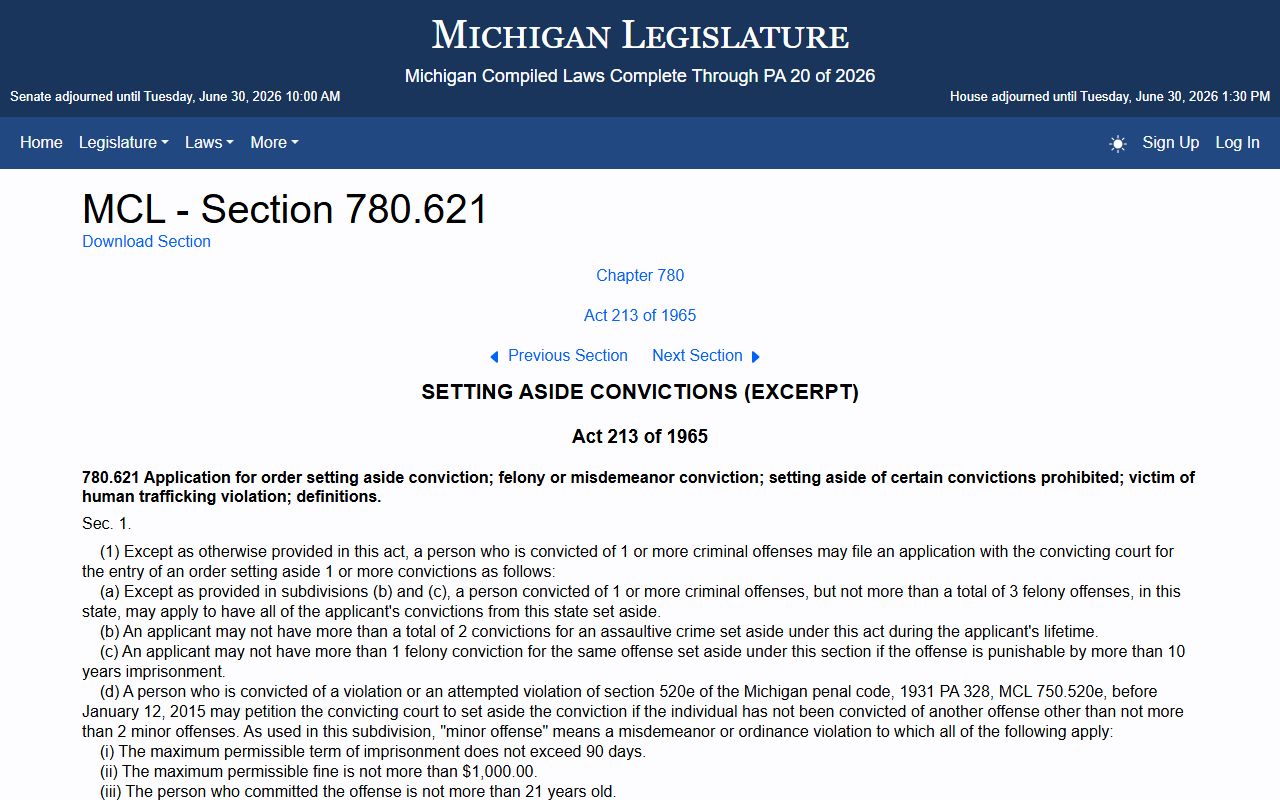
The main set-aside law is MCL 780.621, which sets out how a person applies to clear an eligible conviction. Eligibility depends on the offense type, the number of convictions, the waiting period, and whether the sentence is complete.
| Sealed | Expunged / Set Aside | |
|---|---|---|
| Visibility | Hidden from public search | Treated as though it never happened for public searches |
| Law Enforcement | Limited access | Some agencies keep limited access |
| Eligibility | Set by statute or court order | Set by MCL 780.621 and the Clean Slate laws |
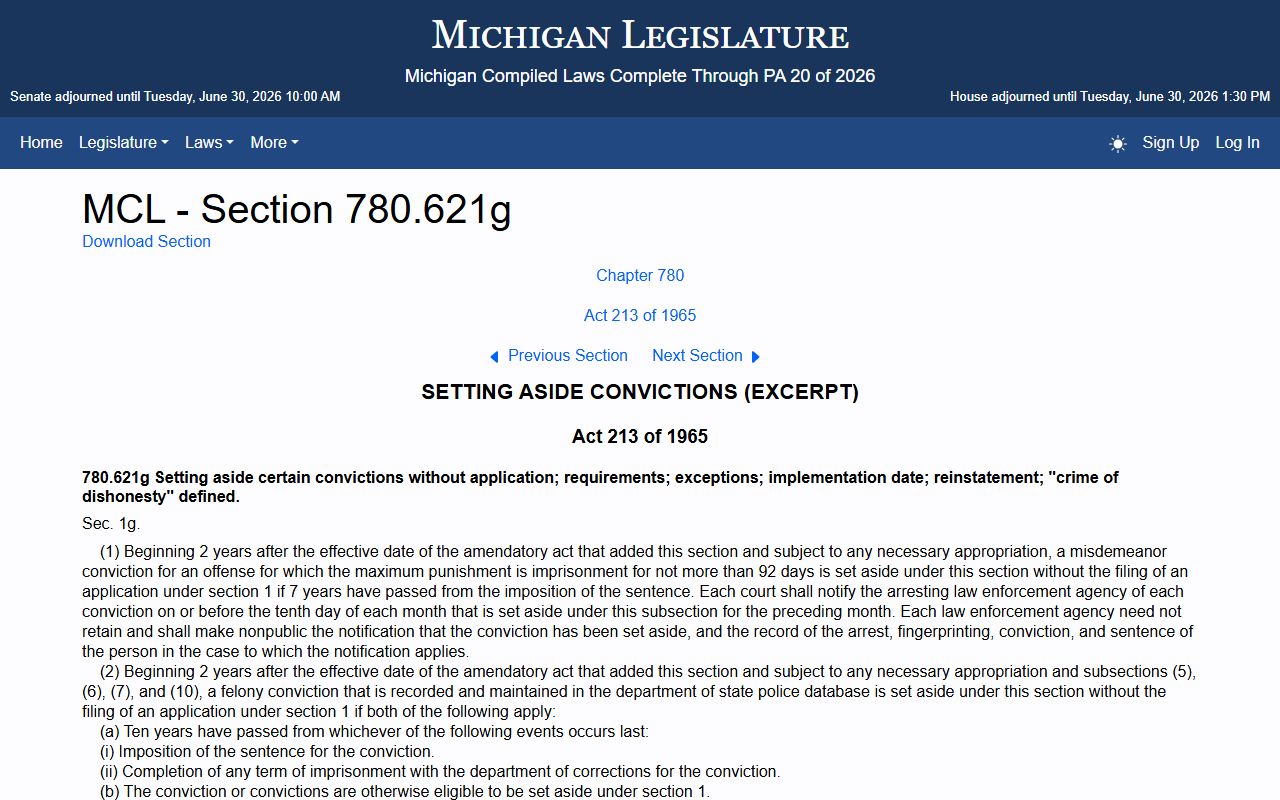
Michigan also runs an automatic Clean Slate program. Certain convictions clear on their own after a set waiting period, with no application needed. The timing rule sits in MCL 780.621g. Once a conviction is set aside by hand or automatically, it should no longer appear as an ordinary public conviction in a criminal court search.
Public Access to Muskegon County Criminal Records
Michigan treats court records as open unless a statute or rule says otherwise. Court case files are governed by court rule, while the state Freedom of Information Act covers many other government records. Together they set the baseline that keeps most adult criminal court records public in Muskegon County. Court case records are best handled through the clerk and MiCOURT, with a public-records request used as a fallback for administrative files.
Key Statutes:
MCR 8.119 - Michigan court rule that governs court records, clerk duties, and public access.
MCL 15.231 - Michigan FOIA policy that people are entitled to full information about government affairs.
Background Check Considerations
A casual name search is not the same as a formal background check. Employers, landlords, and licensing bodies that make decisions under the Fair Credit Reporting Act must use a screening company that follows federal rules. A criminal court search gives a quick public view of a case, but it may miss sealed files, set-aside convictions, or records held by another court. Treat a self-service lookup as a starting point, not a final answer.
Important: This site is not a consumer reporting agency under the Fair Credit Reporting Act, and its records cannot be used for employment, tenant, credit, or licensing decisions.
Restricted Criminal Court Records in Muskegon County
Not every criminal matter is open to the public. Juvenile cases are handled by the Family Division and are often nonpublic, even when a search portal exists. Sealed and set-aside records drop out of public results by law. Files that hold protected personal information, such as social security numbers, are redacted before release. Some records, like adoption and mental-health proceedings, carry strict access limits of their own.
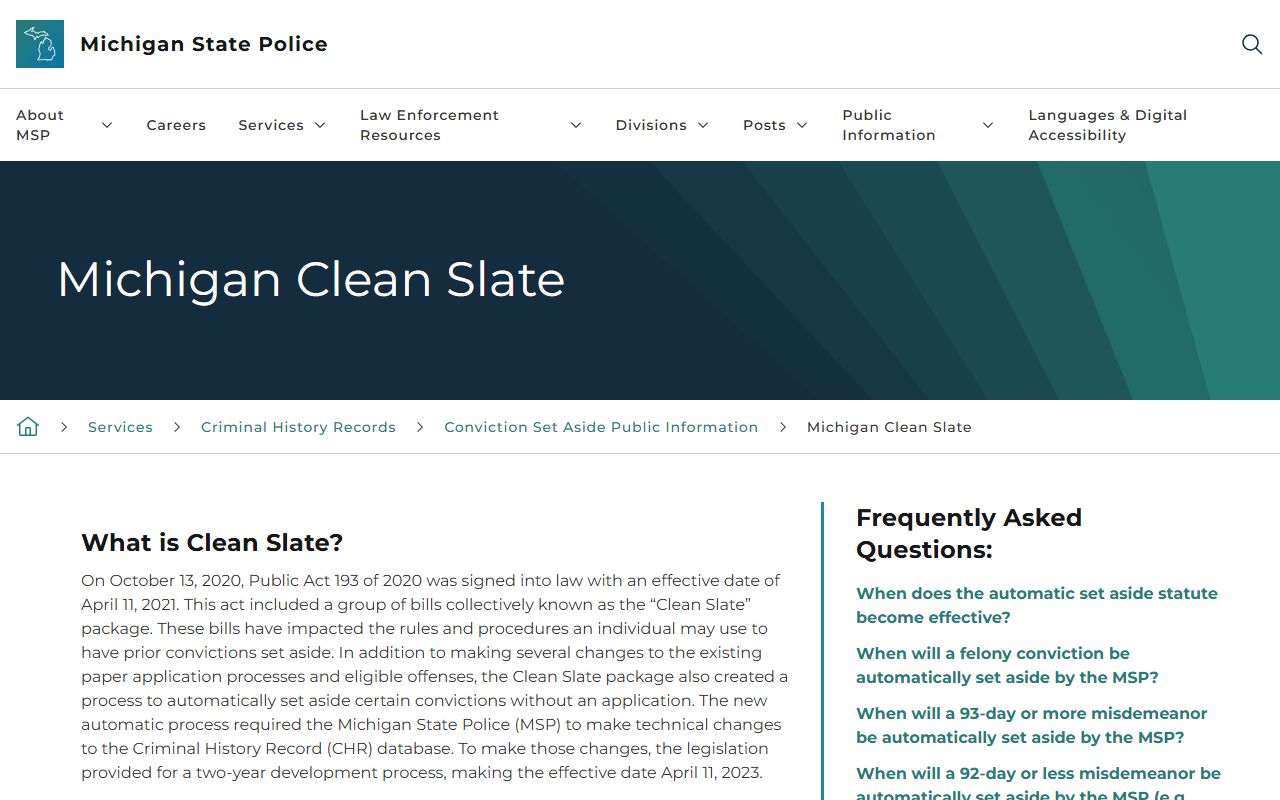
Michigan State Police explain how set-aside convictions are treated on the state Clean Slate page. After a conviction is set aside, public criminal court and criminal-history searches should no longer show it as a standard conviction.