
What Probate Covers in Muskegon County
Probate is the legal process for settling what a person leaves behind and for protecting people who cannot manage their own affairs. In Muskegon County, the Probate Court hears these matters. It handles wills, decedent estates, and trusts. It also oversees guardianships, conservatorships, and mental-health cases. Developmental-disability guardianships and other mental-health-code proceedings run through the same court.
Each type of case builds its own record. A decedent estate opens when someone dies and property must pass to heirs or named beneficiaries. A guardianship protects the person, covering care and daily decisions. A conservatorship protects money and property. Mental-health filings deal with treatment and commitment questions and carry the strongest privacy limits. All of these leave a paper trail that the court keeps, and much of that trail is open to the public.
The Probate Court sits inside the Muskegon County court complex on Terrace Street. It shares the downtown campus with the circuit and district courts, but its cases, forms, and payment system are separate. Probate and juvenile cases even use a distinct online search route, so a search that starts in the wrong court often turns up nothing.
Probate Terms Defined
Probate paperwork leans on a handful of legal words that show up in almost every file. Knowing them helps you read a docket or a will without a lawyer at your side. The terms below appear across Muskegon County probate records.
- Testator
- The person who made a will. When a testator dies, the will is filed with the Probate Court and reviewed before the estate is settled.
- Executor
- The person named in a will to carry out its terms. Michigan filings often call this role the personal representative, who gathers assets, pays debts, and distributes what remains.
- Intestate
- Dying without a valid will. When someone dies intestate, state law decides who inherits, and the court appoints a personal representative to manage the estate.
- Guardianship
- A court arrangement that gives one person authority over the care and personal decisions of another who cannot decide for themselves, such as a minor or an incapacitated adult.
- Conservatorship
- A court arrangement that puts one person in charge of another's money and property. A conservator manages finances, while a guardian manages care.
How to Search Muskegon County Probate Records
The fastest way to look up a case is the county online case-search hub, which splits its links by court level. Probate and juvenile files are not searched through the circuit or district portals. Instead, the county points users to the state MiCOURT system under the Muskegon Probate and Juvenile court code. Public case information such as case numbers, party names where public, and event data may appear online, but document images and juvenile detail can be limited.
- Open the Muskegon County online case-search hub and choose the Probate and Juvenile Court option rather than the circuit or district link.
- Run your search on the MiCOURT Probate and Juvenile case search by party name or case number if you have one.
- If the case does not appear online, visit or call the Probate Court counter at 990 Terrace Street to check the file and request copies in person.
Online results are a starting point, not a certified record. A court printout does not carry the seal that many banks, title companies, and other courts require. For anything official, request a certified copy from the Probate Court itself. Sealed and juvenile matters may never surface online even when a case truly exists.
Muskegon County Probate Court Contact
The Probate Court is the single office that opens, hears, and stores probate cases for the county. It is the right place for estate filings, guardianship and conservatorship petitions, and copies of probate orders. Costs can be paid online or by phone through the county payment vendor. The court page also links transcript instructions and the request form for hearing transcripts.
Muskegon County Probate Court
990 Terrace Street
Muskegon, MI 49442
231-724-6241
Online or phone payment: 888-604-7888, Pay Location Code 6186
Mon-Fri 8:00 a.m.-4:30 p.m.
Payments made through the vendor accept debit cards, Discover, MasterCard, VISA, and American Express. A convenience fee applies, and the pay location code keeps probate money separate from district and circuit accounts. Keep any receipt the system gives you, since it confirms which case and cost the payment covered.
The Muskegon County Probate Process
Most estates move through a familiar set of stages. The path an estate follows shapes the record it leaves, so knowing the stages helps you read what you find.
An estate usually begins with a filing in Probate Court that opens the case and, when needed, asks the court to appoint a personal representative. Once appointed, that representative gathers the assets and files an inventory. Notice goes out to interested persons and to creditors, who then have a window to make claims. The representative pays valid debts, manages or sells assets, and files an accounting that shows the money in and out. When everything is resolved, the estate closes and the remaining property is distributed to heirs or beneficiaries.
Guardianship and conservatorship cases run on a different track. They start with a petition and require the court to find that a person truly needs help. A conservatorship focuses on property and financial management, so its file often includes an inventory and periodic accountings. A guardianship focuses on care and personal decisions, so its file leans toward reports on the protected person's living situation and well-being. Mental-health and developmental-disability proceedings carry added privacy protection and are handled with more restriction than an ordinary estate.
Probate Fees and Transcript Costs
Copy and transcript charges are set by rule and by the court's transcript request form. A transcript is a written record of what was said at a hearing, and it is priced by the page. The court's request form lets you pick a standard rate or an expedited rate, and it lists a minimum charge. The figures below come from the Probate Court transcript instructions and request form.
| Item | Amount |
|---|---|
| Transcript minimum fee | $50.00 plus $0.90 per page copy |
| Statutory transcript rate (up to 30-day turnaround) | $4.65 per page ($3.75 original, $0.90 copy) |
| Expedited transcript rate | Additional fees set by the transcriptionist |
| Online or phone payment | Pay Location Code 6186, convenience fee applies |
To order a transcript, complete the Probate Transcript Request Form, which asks for the file number, the type and date of hearing, the judge or register, and your contact details. After you submit it, the transcriptionist reaches out with an estimated cost before the work begins. Certified probate copies are separate from transcripts and are quoted at the counter based on the document and page count.
Note: Court costs and filing amounts change over time, so confirm the current figure with the Probate Court before you send payment.
Recorded Probate Instruments at the Register of Deeds
Some probate documents also land in the county land records. The Register of Deeds keeps a separate office and an online index that includes probate-related instruments. That index can confirm that a will, an order, or a grant of authority was recorded, which is useful when you only need to prove the document exists.
You can browse the land index through the deeds office search portal. It is an index, not the full probate court file, so treat it as a pointer rather than a substitute for the case record.
The lead-in to the guest index sits on the Register of Deeds document search page, where a public visitor can open the search without an account.
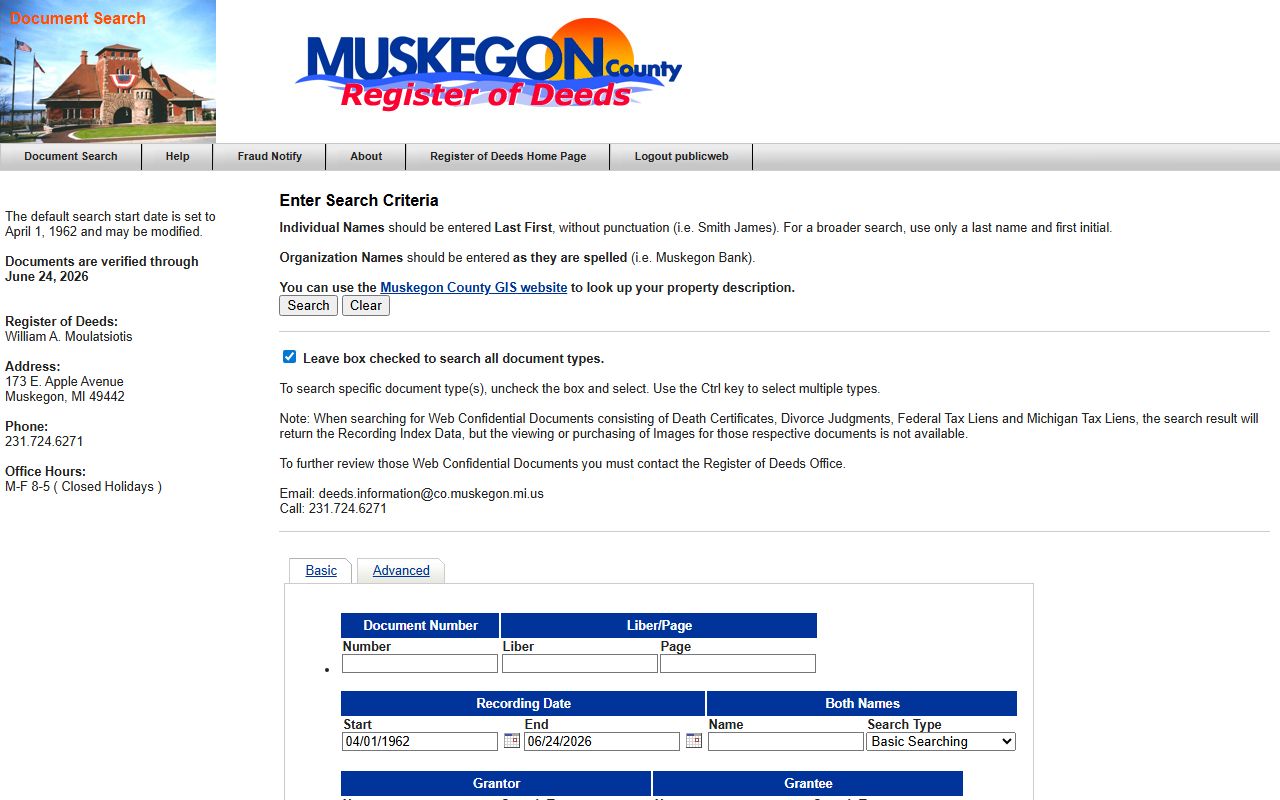
Once inside, you can filter by document type. The dropdown lists recorded probate instruments such as WILL, ORDER ADM.WILL, ORDER FIN ACCT, LETTERS OF AUTH, PETITION&ORDER, and OTHER PROBATE, along with fiduciary and trust deeds. Names are entered last name first without punctuation. For court-certified probate copies, though, you still return to the Probate Court, since the deeds index only shows the recording data.
The deeds office is at 173 E. Apple Avenue and can be reached at 231-724-6271 during weekday business hours. Certain sensitive documents in the index return only the recording data and cannot be viewed or purchased online, so those require direct contact with the deeds staff.
Restricted Muskegon County Probate Records
Not every probate file is open to the public. Mental-health and developmental-disability proceedings sit among the most protected records the court holds. These cases often contain private health information, and access is limited by law and by court order. A member of the public should not expect to freely browse a commitment or treatment file.
Juvenile matters that share the Probate and Juvenile court route are also restricted. Delinquency, child-protective, and related juvenile files are not treated like ordinary adult cases, even when the online search path exists. Michigan sets a separate process for setting aside juvenile adjudications, and eligibility depends on the offense, waiting periods, and other statutory limits rather than a simple request.
The rules for clearing a juvenile record are found in the state statute on setting aside juvenile adjudications, published on the Michigan Legislature site under MCL 712A.18e.
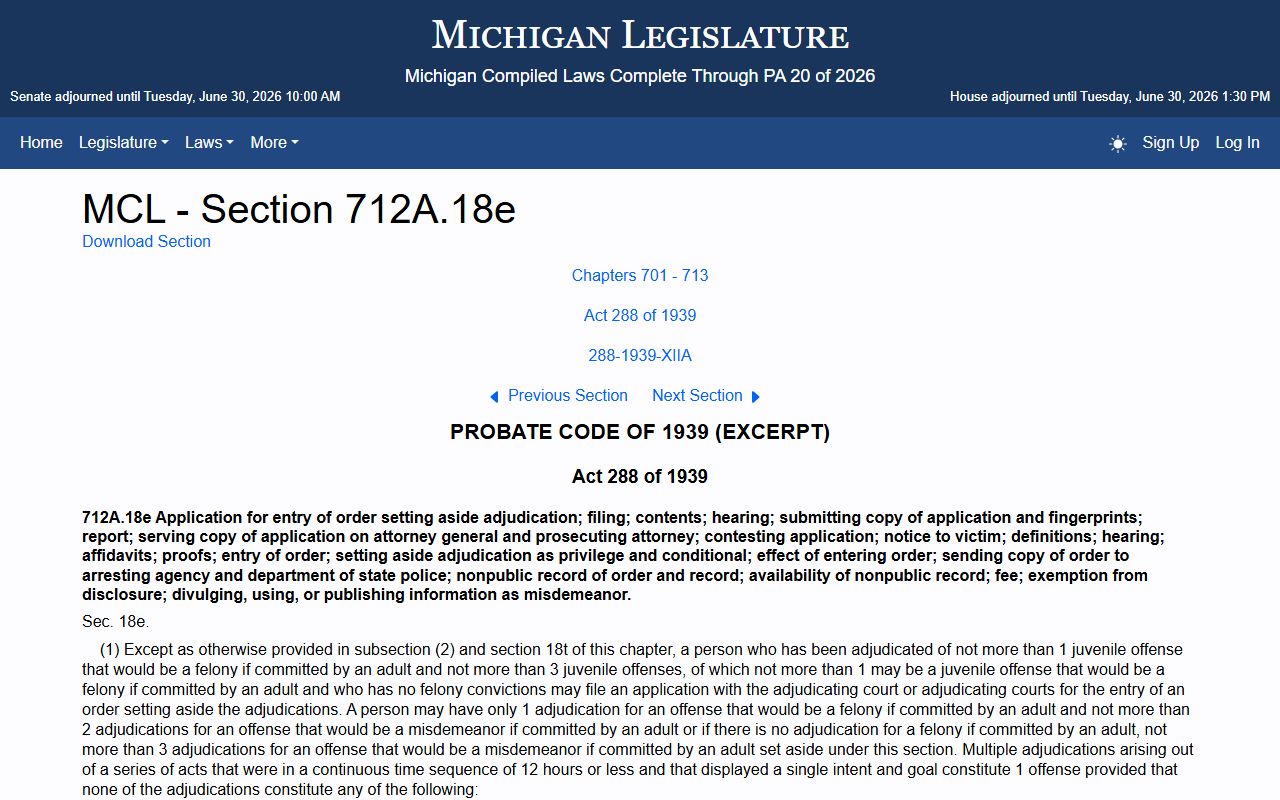
Because these limits exist, a probate search sometimes returns less than a person expects. When a file is sealed or a case is nonpublic, the court will not release it without proper authority. If you believe you have a legal right to a restricted record, contact the Probate Court directly and ask what documentation or court order is needed to view it.