
How to Search Muskegon County Court Records
Muskegon County court records are searched through the county online case search hub, which sorts every case into three groups. The first group is the circuit court, which holds felony files after bindover, larger civil suits, business court matters, divorce, custody, and personal protection orders. The second is the district court, which holds misdemeanors, civil claims of $25,000 or less, small claims, evictions, and traffic. The third route covers probate and juvenile files such as estates, wills, guardianships, and mental health matters. Picking the right group first keeps a search from stalling on the wrong court.
A name or a case number is enough to begin. Names work best entered last name first. A case number pulls a single file fast. Older circuit files may not show online at all, because the clerk keeps only recent records on site and stores the rest off site.
The Muskegon County government homepage links out to the courts, the forms, and the case search tools most residents need. That page is the simplest doorway for anyone unsure where a court record sits.
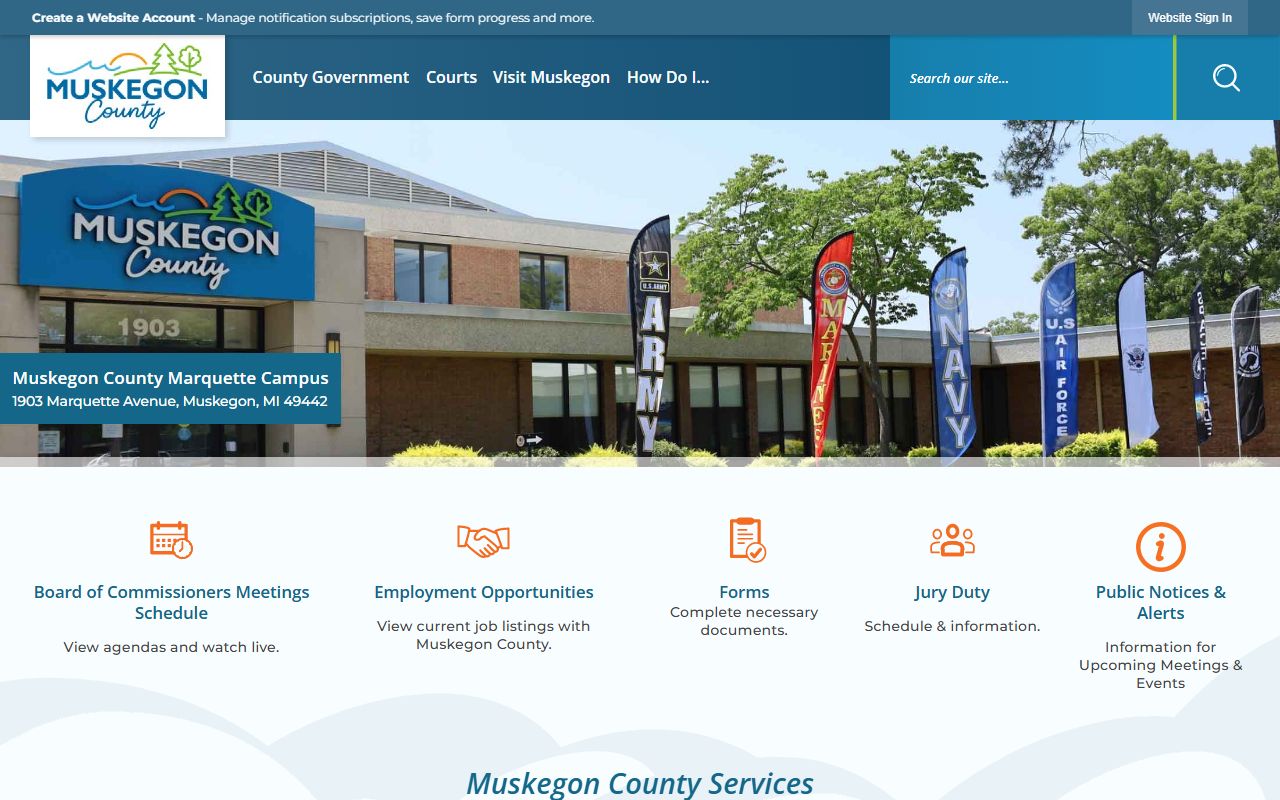
From the homepage a reader can reach the online case search hub in a couple of clicks. The steps below walk through a single search from start to finish.
- Open the county online case search hub and choose circuit court, district court, or probate and juvenile.
- Enter a party name last name first, or type a known case number.
- Narrow the results by court type and filing date to trim the list.
- Open a case to read its docket entries, parties, charges, and hearing dates.
- Request a certified copy from the clerk counter when a portal printout will not be accepted.
The Muskegon County Judicial System
Michigan runs one statewide court system, and Muskegon County sits inside it with local trial courts. The Michigan Supreme Court sits at the top. The Michigan Court of Appeals reviews most appeals from circuit and probate judges. Below them, the 14th Circuit Court is the trial court of general jurisdiction for the county. The 60th District Court is the limited-jurisdiction court that handles smaller matters. The Probate Court manages estates and protective proceedings.
Felony cases begin in the district court for arraignment and a preliminary exam. If a judge finds probable cause, the case is bound over to the circuit court for trial and sentencing. Misdemeanors stay in the district court from first appearance through sentencing. Appeals from district court rulings usually go to the circuit court.
Case flow: 60th District Court › 14th Circuit Court › Michigan Court of Appeals › Michigan Supreme Court
Michigan's official trial-court overview confirms this circuit, district, and probate structure that shapes every Muskegon County court record. The table below shows which local court hears which kind of case.
The split matters because a single event can appear in two courts. A felony often opens in district court and later moves to circuit court under a new case number.
| Court | Jurisdiction | Case Types |
|---|---|---|
| 14th Circuit Court | General jurisdiction trial court | Felonies after bindover, civil above the district limit, divorce, custody, PPOs, business court |
| 60th District Court | Limited jurisdiction trial court | Misdemeanors, civil to $25,000, small claims to $7,000, traffic, evictions, felony arraignments |
| Probate Court | Probate and mental health | Wills, estates, trusts, guardianships, conservatorships, mental health matters |
Muskegon County Courthouses and Offices
The Muskegon County court-record workflow centers on 990 Terrace Street in downtown Muskegon. The Michael E. Kobza Hall of Justice at that address holds the 14th Circuit Court, the 60th District Court, the Probate Court, the Sheriff's Office, the Prosecutor, and the Circuit Court Records counter. The County Clerk's vital records office is not in that building. It sits at the Marquette Campus a short drive away. The Register of Deeds keeps land-related records at its own downtown address.
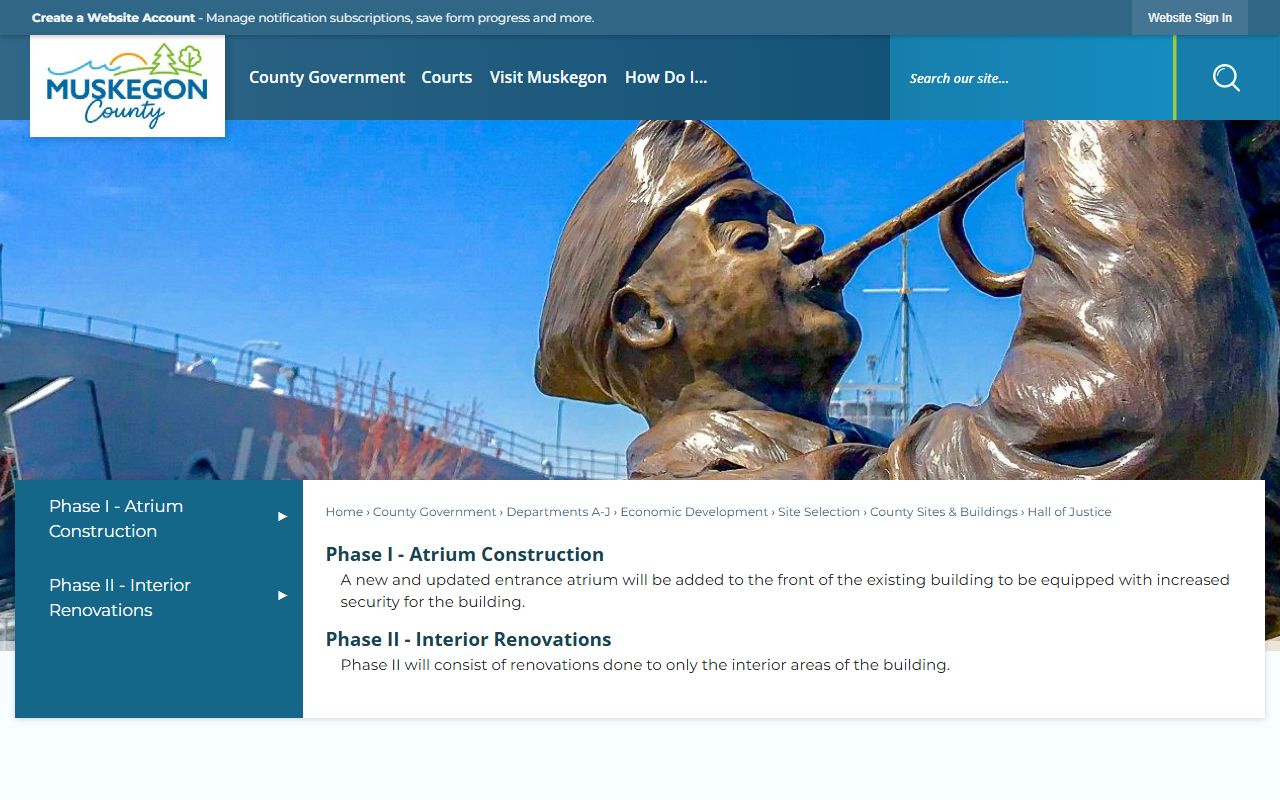
The county's Hall of Justice page serves as the main visual for the downtown court complex. Court users should keep the clerk's vital records counter separate from the court counters, since marriage licenses and certified birth or death copies route to the Marquette Campus.
The address cards below point to the three offices most record seekers use.
Hall of Justice / Circuit Court Records
990 Terrace Street, 6th Floor, Suite 600
Muskegon, MI 49442
231-724-6251
County Clerk / Vital Records
1903 Marquette Ave., Suite A104
Muskegon, MI 49442
231-724-6221
Types of Court Records Available in Muskegon County
Muskegon County court records fall into a handful of case types, and each type lives with a different court or office. Criminal and civil files split between the district and circuit courts by seriousness and dollar amount. Family and divorce files belong to the circuit court's family division. Estate and guardianship files belong to the probate court. Traffic and small claims stay in the district court.
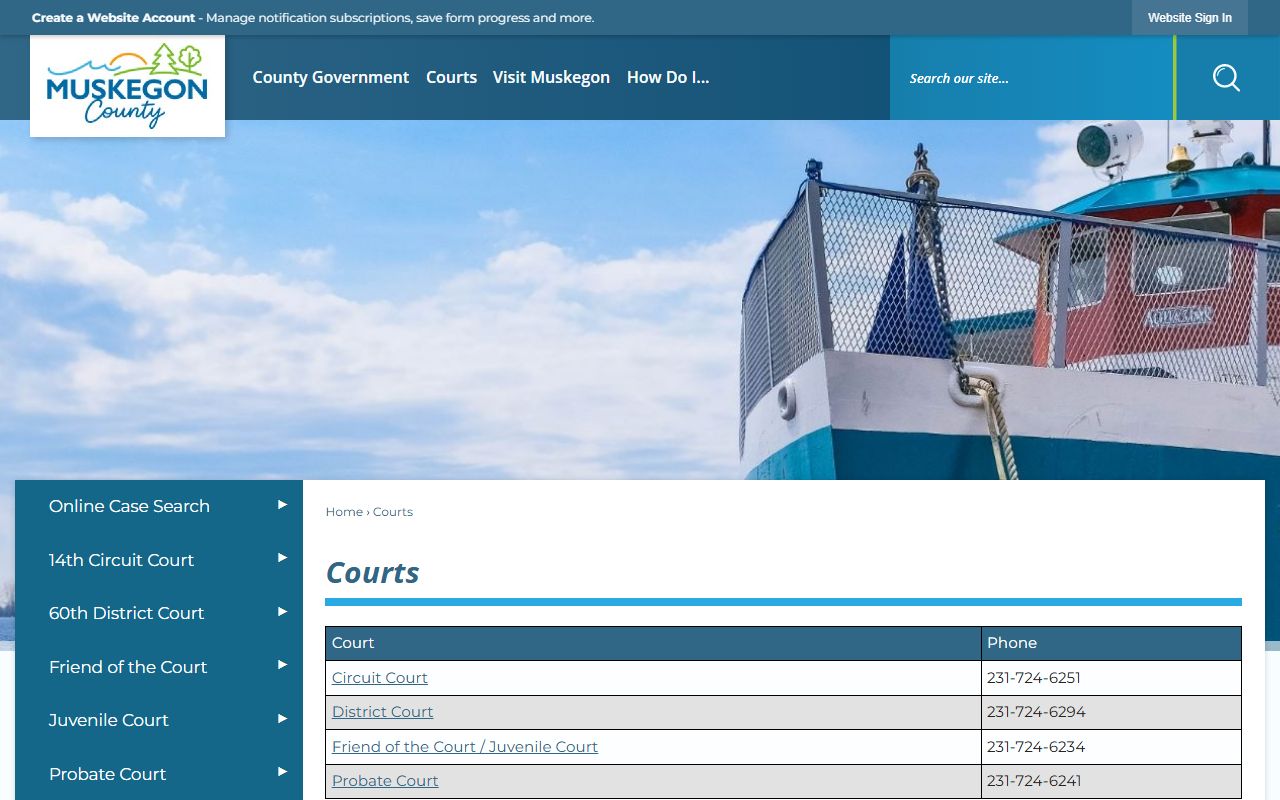
The county courts landing page links to each of these divisions along with their dockets and forms. It is a useful map when a record type is not obvious.
The list below groups the common record types by what they cover.
- Criminal records - all county prosecutions start in the 60th District Court, and felonies continue in circuit court after bindover.
- Civil records - district court hears claims of $25,000 or less, while larger suits and business court sit in circuit court.
- Family and divorce records - divorce, paternity, support, custody, and PPO files are kept by Circuit Court Records.
- Probate records - wills, estates, trusts, guardianships, and conservatorships run through the Probate Court.
- Traffic records - civil infractions, points, and citation payments are handled by the district court.
A quick comparison shows how the two trial courts and the probate court divide the work.
| Feature | District Court | Circuit Court | Probate Court |
|---|---|---|---|
| Civil limit | $25,000 or less | Above $25,000 | Estate value |
| Criminal role | Misdemeanors, felony start | Felony trial and sentence | None |
| Family and estates | None | Divorce, custody, PPOs | Wills, guardianships |
What Muskegon County Court Records Show
A Muskegon County court record gathers the paperwork and events from a single case. Most files open with a case number that names the court and the case type. From there the record tracks the people involved, the claims or charges, and every hearing along the way. Criminal files name the People of the State of Michigan against a defendant, while civil files name a plaintiff and defendant, and family files may use petitioner and respondent.
The fields below appear across most court and jail records in the county.
- Case number
- Identifies the file and signals the court and case type through its suffix.
- Parties
- Lists the plaintiff and defendant, or petitioner and respondent, tied to the case.
- Charges or cause
- Shows the statute or offense description in criminal files and the claim in civil files.
- Docket entries
- Records arraignments, motions, orders, hearings, judgments, and sentencing in order.
- Financial fields
- Covers fines, costs, restitution, bond, and copy or certification fees.
- Hearing schedule
- Notes the hearing type, date, courtroom, and judge where the case is public.
Case-number suffixes give quick hints about the court and level. Suffixes like OM point to ordinance or misdemeanor matters, SM to misdemeanor matters, and FH or FC to felony and circuit-level files. A record should be read with care. A charge is only an accusation, and it is not the same as a conviction until a court enters a judgment.
Searching Muskegon County Case Records Online
The county online case search links to the Michigan judiciary's MiCOURT system, with a separate route for each local court. One route covers the 14th Circuit Court, one covers the 60th District Court, and one covers Probate and Juvenile matters. A user picks a court, then searches by party name or case number. Public results usually show the case number, party names where public, the court, the case type and status, and hearing information.
The search fields below reflect the common MiCOURT workflow for each court route.
| Field | Type | Notes |
|---|---|---|
| Court route | Link | Separate pages for Circuit, District, and Probate/Juvenile |
| Party name | Text | Enter a last name first for the broadest match |
| Case number | Text | Use when the number is known, such as 26-001767-FH |
| Case details | Result link | Opens docket, parties, and hearing data where public |
Michigan court policy often allows online case information while limiting document images that may still hold protected personal data. A portal printout is a reference, not a certified copy.
Note: If an older circuit case does not appear online, order the file through Circuit Court Records and allow at least five days for delivery from off-site storage.
Public Access Laws for Muskegon County Court Records
Michigan treats government records as open to the public, subject to limits set by statute and court rule. County administrative records fall under the state Freedom of Information Act, while court case files follow judiciary court rules and clerk procedures. That is why a court record request usually goes to the clerk or MiCOURT first, and a FOIA request goes to the county for administrative or sheriff records.
Key Statutes:
MCL 15.231 - Michigan's Freedom of Information Act declares the public policy that people may see full information about government affairs.
MCL 15.235 - A public body must answer a records request within the statutory period, with a short extension allowed.
MCR 8.119 - This court rule sets how clerks keep court records and which parts remain nonpublic.
MCL 780.621 - This statute lets people apply to set aside eligible convictions so they no longer show as public.
The county processes public-records requests within five business days, with a possible ten-day extension. Requests for city police matters in Muskegon, Muskegon Heights, Muskegon Township, or Norton Shores route to those departments instead of the county sheriff.
Restricted and Confidential Muskegon County Records
Not every file the courthouse keeps is open to the public. Juvenile case records get stronger protection than ordinary adult files, so delinquency and child-protective matters are not freely searchable. Adoption records carry strict access limits and route through an adoption coordinator. Mental-health proceedings in the Probate Court often hold protected health information and stay restricted. Court rules also require the redaction of Social Security numbers, financial account data, and other protected personal identifiers.
Set-aside and expungement law can also hide an old conviction from public view. Circuit Court Records sells a set-aside conviction packet for $5.00, and the county charges no filing fee for the application itself. Michigan's Clean Slate program can set aside eligible convictions automatically after set waiting periods. Eligibility depends on the offense type, the number of convictions, and the time since the sentence ended, so a record seeker should not read a cleared file as proof of a hidden crime.
Specialty Courts in Muskegon County
Muskegon County runs several problem-solving courts that change how a criminal case ends. These programs mix supervision, treatment, and regular court appearances in place of a standard sentence. They feed back into the court record because they affect supervision, alternative sentencing, and final disposition.
Three programs anchor this work in the county.
- Sobriety Court - a voluntary 18-month misdemeanor program for alcohol and substance-abuse offenders, run through the District Court.
- Veterans Treatment Court - a five-phase program of about 18 months for veterans facing charges tied to substance abuse or mental illness.
- Mental Health Court - a three-phase program with at least twelve months of supervision for people with mental-health and co-occurring disorders.
The county describes these on its problem-solving courts page. Screening for each program runs through legal and clinical review before a person is admitted.
Muskegon County Sheriff and Jail Records
The Muskegon County Sheriff's Office runs the county jail and posts public inmate reports. A public Zuercher reports portal shows pre-arraignment and post-arraignment rosters. The post-arraignment report lists a booking date, hold reason, disposition, charges, court docket, bond type, judge, and bond amount, so it can reveal court charges before the full case file turns up. It is a roster report, not a profile page, and it does not show mugshots or dates of birth.
The Sheriff's Office page links to inmate search, FOIA, tip submission, and the VINE custody-alert tool. For a full roster walkthrough, see the Muskegon County inmate records page, and for holds tied to a bench warrant, see the warrant records page.
Muskegon County Sheriff's Office
990 Terrace Street, Suite 450, 4th Floor
Muskegon, MI 49442
231-724-6351
Records Division on the 1st Floor, closed for lunch 12:00 p.m. to 1:00 p.m.
Marriage, Divorce, and Probate Records in Muskegon County
Marriage and divorce records live in two different offices. The County Clerk issues marriage licenses and certified marriage copies at the Marquette Campus, with a resident license fee of $20.00. Divorce case files belong to the circuit court's family division and are kept by Circuit Court Records. A reader can start with marriage and divorce records for the request steps, and with probate records for estate and guardianship files.
Probate cases use their own set of terms, and a few come up in almost every estate file.
- Testator
- A person who makes a will that directs how property passes at death.
- Personal representative
- The person named to carry out a will, also called an executor.
- Conservator
- A person appointed to manage another adult's property and finances.
- Guardian
- A person appointed to make care and personal decisions for another.
Muskegon County Court Records Fees
The clerk charges set fees for copies and certain filings. Plain copies are billed by the page. Certified copies add a certification fee on top of the per-page cost, and the office cannot certify a document that a person brings in from outside. A few common court-records fees appear below.
| Item | Amount |
|---|---|
| Plain copy (per page) | $1.00 |
| Certification fee | $10.00 plus $1.00 per page |
| Legal name change filing | $187.00 |
| Set-aside conviction packet | $5.00 |
Important: A certified copy is required for many legal purposes, and an uncertified portal printout will not be accepted in court, so order certified copies from the clerk counter when they matter.
Getting to the Muskegon County Courthouse
The court complex sits in the downtown Muskegon government area near the Terrace Street and Apple Avenue corridors. Drivers often reach it from US-31, I-96, and M-46 along Apple Avenue before turning onto local downtown streets. Because the county links out to map directions rather than publishing turn-by-turn routes, plan the last few blocks with a live map on the day of a hearing.
Public transit riders can verify routes through the Muskegon Area Transit System. The MATS system map shows the fixed routes that serve downtown Muskegon and the court area.
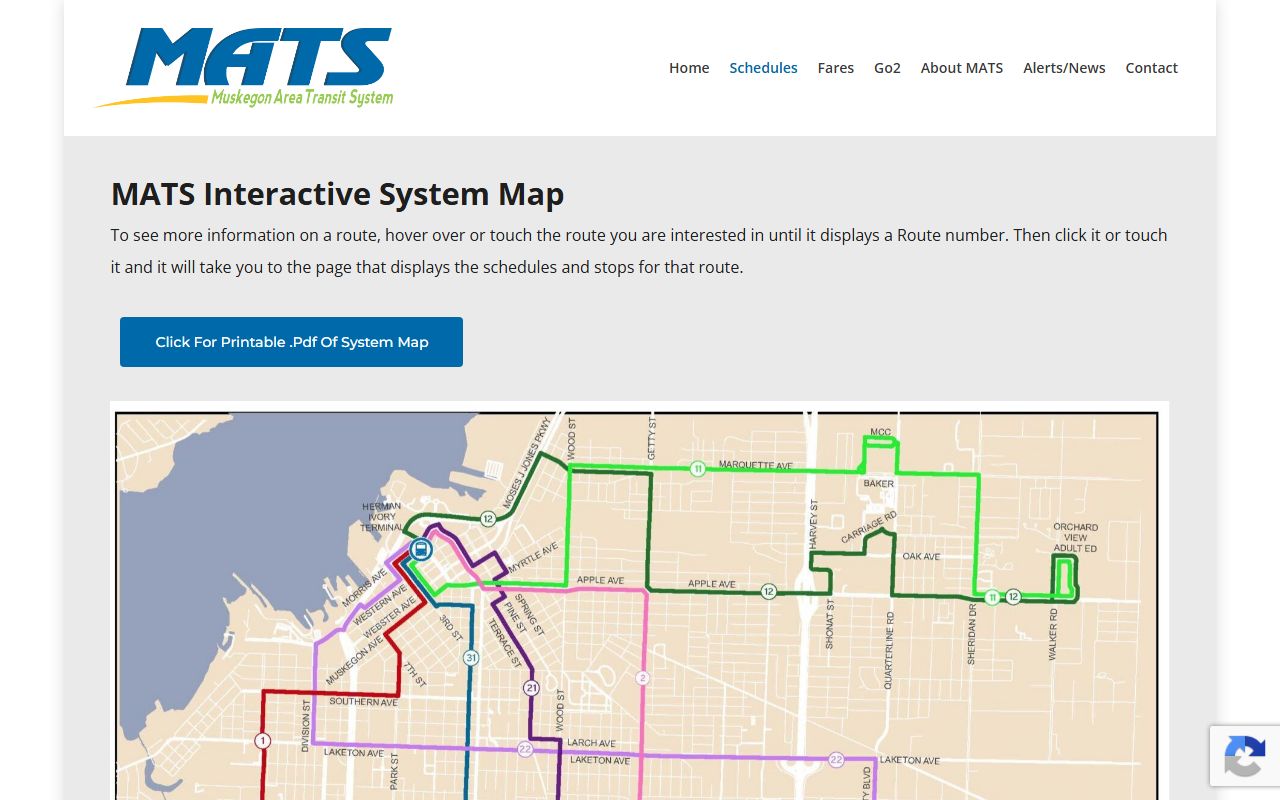
The system map is best paired with a live view of where each bus is running. The MATS real-time map tracks buses and stops as they move.
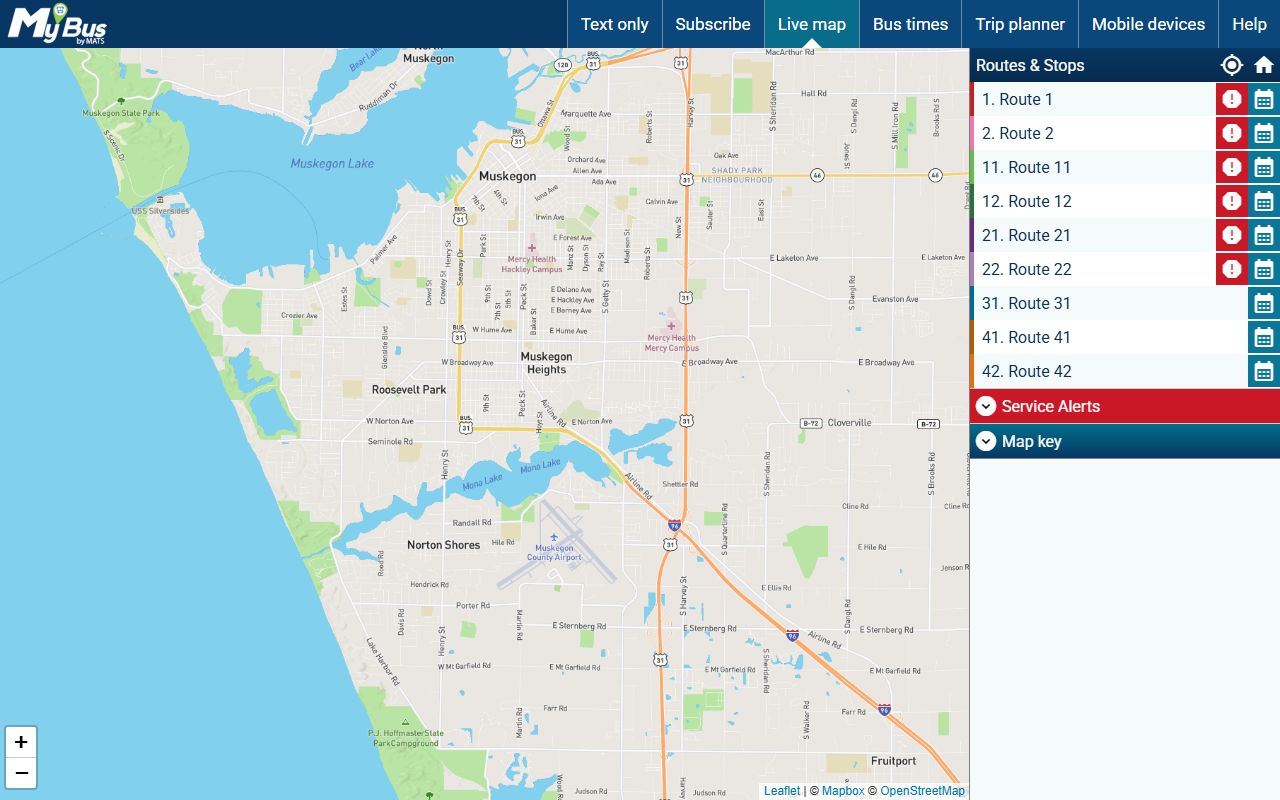
The real-time map shows downtown stops such as 3rd and Western, 3rd at Hackley Library, 3rd at Hackley Park, and 7th and Houston. Riders from lakeshore townships and outlying cities can use these tools to time a trip to either the Hall of Justice or the Marquette Campus.
History of the Muskegon County Courts
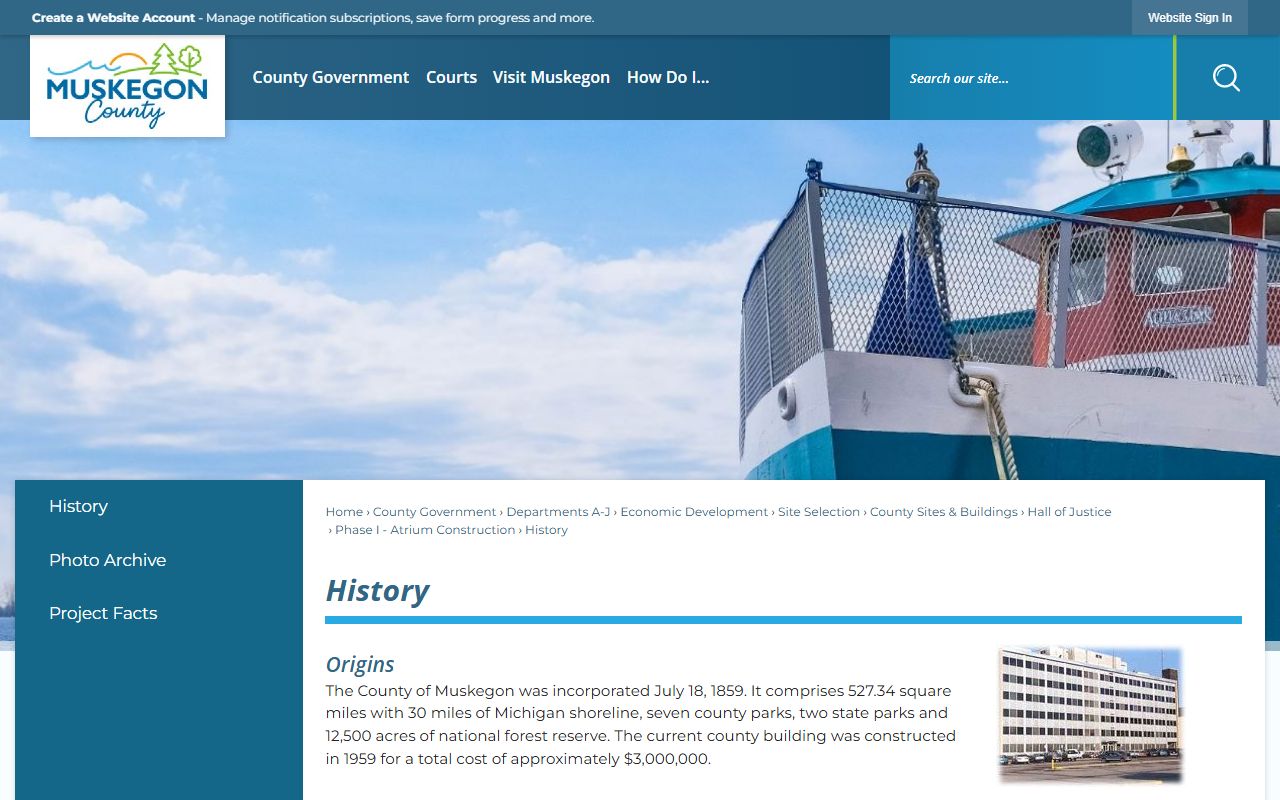
Muskegon County was incorporated on July 18, 1859, and the county seat is the city of Muskegon. The current county building was constructed in 1959 for roughly $3,000,000, which gives the court complex a mid-20th-century civic history rather than a preserved 19th-century courthouse. The county's own history material stresses its Lake Michigan shoreline, county parks, and forest reserve, a reminder that many record seekers travel in from rural townships and lakeshore communities.
The county's history page holds these founding details. More recent court history includes the 2014 opening of the county Public Defender Office under a holistic-defense model and the growth of the specialty courts that now shape criminal case outcomes.
These reforms show up in the court record itself, through supervision terms, alternative sentencing, and appointed counsel noted in the docket.
Frequently Asked Questions
Where do I search Muskegon County court records online?
Start at the county online case search hub, which links to the Michigan MiCOURT system. It offers a separate route for the 14th Circuit Court, the 60th District Court, and Probate and Juvenile matters. Pick the court that matches the case type, then search by party name or case number. Older circuit files may not appear online and can be ordered through Circuit Court Records.
What is the difference between circuit court and district court records?
The 60th District Court handles misdemeanors, civil claims of $25,000 or less, small claims, traffic, and evictions, and it starts every felony with an arraignment and preliminary exam. The 14th Circuit Court takes the full felony case after bindover, larger civil suits, and family matters such as divorce and custody. One criminal event can appear in both courts under different case numbers.
How do I get a certified copy of a Muskegon County court record?
Request a certified copy at the clerk counter that holds the file, not from an online printout. Circuit Court Records charges a $10.00 certification fee plus $1.00 per page. The office cannot certify a document that a person brings in from outside. Certified copies are the version courts and agencies accept for legal use.
Are Muskegon County marriage and divorce records in the same office?
No. The County Clerk issues marriage licenses and certified marriage copies at the Marquette Campus vital records counter. Divorce case files belong to the circuit court's family division and are kept by Circuit Court Records at the Hall of Justice. A divorce judgment may also appear in the Register of Deeds index, though images for those documents are restricted.
Can I check for a warrant in Muskegon County online?
The county does not publish a standalone public active-warrant list. People in custody on a warrant hold can appear in the sheriff's public jail reports, which show the hold reason, docket, bond, and judge. To resolve a warrant, identify the issuing court and call it directly. Bench warrants cannot be paid with a credit card.
How long does it take to get an older court file?
Circuit Court Records keeps only recent files on site, with family files from 2009, criminal files from 2013, and civil files from 2014. Older files sit in off-site storage. After a request is placed, the office needs a minimum of five days to retrieve the file and notifies the requester by phone.